1815-1914

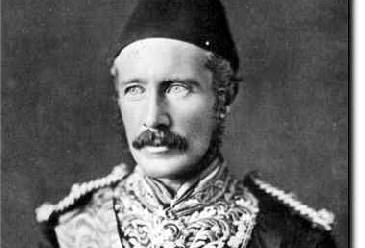
General Gordon
An Engineer in the Army
General Gordon is best remembered for being killed in the defence of Khartoum against the forces of the Mahdi, but he had become a well-
Gordon was born in Woolwich on January 28, 1833 and entered the Royal Military in Woolwich in 1847. Upon graduation he joined the Royal Engineers in 1852. He served in the Crimean War from January 1855 to the end of the siege of Sebastopol, and then spent two years surveying the borders between Russia and Turkey. In 1860 Gordon was sent to China where he took part in the expedition to force the Emperor to ratify previously agreed treaties. Gordon was part of the British force that occupied Peking and sacked the Summer Palace, regarded as one of the worst crimes of the c19th.
The Destruction of the Summer Palace
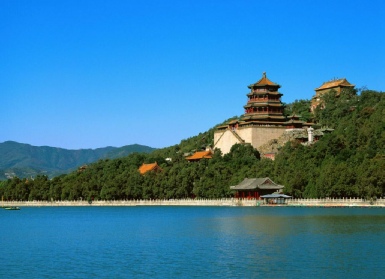
The Chinese government today estimates that about 1.5 million items were taken from the Summer Palace. Whilst this figure is speculative, even Elgin emphasised the size of the place and the scale of pillaging, writing: “There was not a room I saw in which half the things had not been taken away or broken in pieces.” Even the Emperor’s dogs were taken, and one given to Victoria, being christened ‘Looty’.
The Imperial Summer Palace
The Summer Palace – Yuan Ming Yuan in Chinese -
Subsequent to the taking of the palace and the occupation of Peking, Lord Elgin signed the peace treaty with Prince Kung on 24 October. Gordon remained in China and was given command of a force whose task was to subdue a rebellion by the Taipings during the civil war which had been fought between the Taipings and the Manchu led Qing dynasty. Gordon’s force fought thirty three actions against the Taipings, in the process taking numerous walled cities and helping to crush the rebellion. For his efforts Gordon was henceforth nicknamed ‘Chinese Gordon’.
Sent to the Sudan
Returning to England Gordon was based at Gravesend. When free of his engineering duties Gordon used his time to visit the poor and sick, teaching waifs and strays. After working on the navigation of the Danube in 1871-
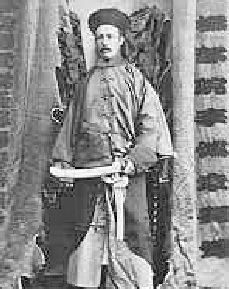
‘’Chinese’ Gordon
British annexation of Egypt and Sudan
Sudan at the time was regarded as effectively an Egyptian colony and with the defeat of the Egyptian army in 1882 by Wolseley, it became of British interest. Gordon had criticised the involvement of Britain in the administration of Egypt saying it went against the ‘liberty of the people’ and asking ‘What right have we to make ourselves guardians of Egypt with our pauper office makers. The people do not want us.’ Such a view was quite common amongst leading military figures including General Garnet Wolseley and Sir William Butler who said that the comet seen prior to the defeat of the Egyptian army at Tel-
Resignation from the Army and sent to Sudan
In England Gordon had resigned from the army and wrote to Wolseley about his pension. The two men met in London at the War Office on 15 January, 1884, but did not discuss the situation in the Sudan. Subsequently though Gordon agreed to go to Suakin in Sudan to assess the situation if asked to do so. Gordon went to Belgium and got the agreement of Leopold to delay Gordon’s work in the Congo. Gordon then met with four members of the cabinet and Wolseley. It was agreed that Gordon would go to Sudan although afterwards those present couldn’t agree on what had been said.
On 18 January 1884 Wolseley, Hartington and the Duke of Cambridge bid goodbye to Gordon as he boarded a train, the first part of his journey to Sudan. Arriving in Alexandria, Egypt, Gordon was persuaded to travel to Cairo by Evelyn Baring, the senior British official in Egypt. In Cairo the nature of the expedition changed. Now Gordon was to be made governor general of Sudan and was to organise an evacuation of Sudan by the British and Egyptian forces before leaving in place a Sudanese administration. Once Gordon had arrived in Khartoum he decided to stay and defend the city and defeat the Mahdi. Messages from Gordon to the British public were highly emotional and called upon the country to help save Sudan from the forces of evil and darkness. Gordon regarded it as his Christian duty and the country’s duty to save Sudan from Islamic forces but all the time that Gordon remained in Khartoum the Mahdi was consolidating his hold over Sudan. He was concentrating his forces around Khartoum from May 1884 and the British press saw it as a race between the relief force sent, commanded by Wolseley, and the forces of the Mahdi.
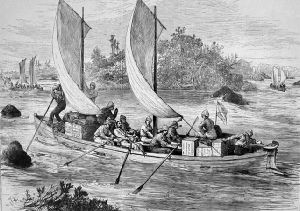
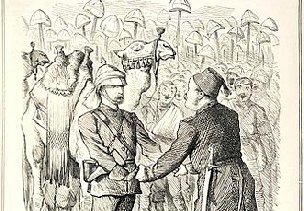
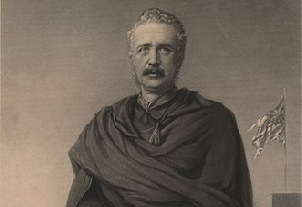
From left: Wolseley’s Relief force, an image depicting the expected meeting between the relief force and Gordon, and Gordon as he was in Khartoum
Wolseley arrives just two days late
Wolseley’s advance force under Stewart crossed the Bayuda desert in January whilst the main force was travelling slowly down the Nile. Having arrived at the Nile a small force was sent down the Nile aboard three steamers. They arrived off Khartoum on 28 January to find the city had been taken by the Mahdi just two days earlier.
What had happened to Gordon? The Mahdi had wanted Gordon captured alive, but eye-
When Wolseley was told the news on 4 February, he was in despair at the death of an old friend. He wrote to his wife, Louisa, ‘Oh my dear child. I am in despair – news has just come in that Khartoum was taken by treachery on 26 January, my steamers reached Khartoum on 28th January just in time to see it occupied by the enemy and have a very heavy fire opened upon them from Mahdi’s batteries – I have telegraphed home for fresh instructions, for now I learn I have no mission left to carry out. I have proposed to concentrate my little army at Debbeh……and there await events. ‘poor Gordon! For his sake I hope he is dead. I should think this blow will kill poor old Gladstone -
How was Gordon killed?
Later accounts from those not present, claimed that Gordon had stood straight, erect and appearing indifferent to his fate at the top of the stairs leading to the British Residency in Khartoum. This is the version adopted by Sir Reginald Wingate of the intelligence department who realised it was a fitting end for a Christian hero. Wingate hoped that such a martyrdom would inspire the British to take revenge on the Sudan on Gordon’s behalf. This was the version adopted by the British press and later in 1893 in the painting by George Joy. Gordon’s death brought forth huge national grief which was later assuaged when Kitchener defeated a Sudanese army at the Battle of Omdurman.
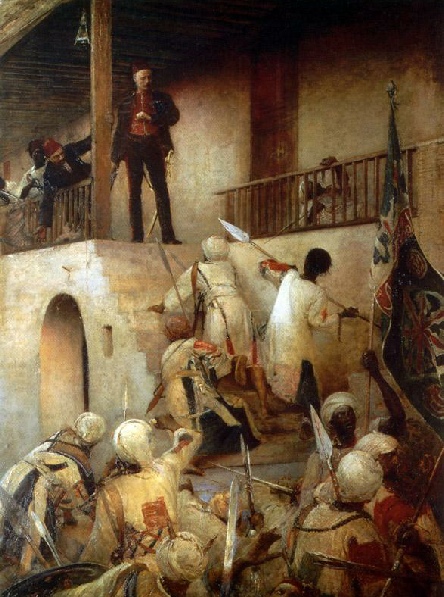
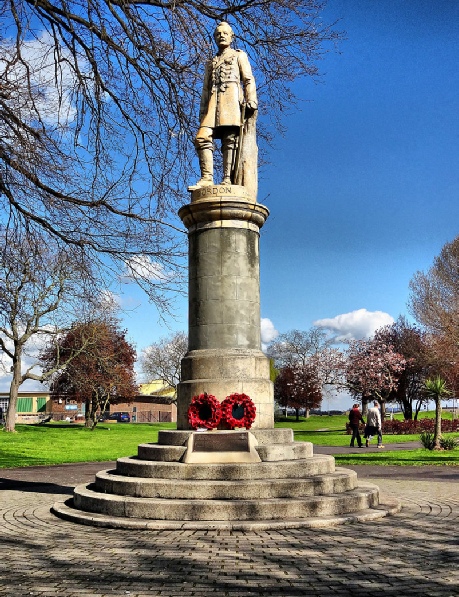
Above left: Gordon’s statue in Gravesend Above right: George Joy’s 1893 painting of the imagined death of General Gordon