




British Migration in the 17th and 18th Centuries
The attempts of Raleigh to establish settlements in Chesapeake Bay in the late 16th century ended in failure with all the settlers dying and just one skeleton found however that was not to affect the hopes and aspirations of others who in the early 17th century saw the establishment of colonies as a means of securing the riches of the Americas and a way offering a way of earning large profits for the organisers and a new life for the settlers. Over the next two hundred years, the British would establish a dominant empire in the Americas based on the eastern seaboard of what is now the United States and the island of the Caribbean. By 1700 there were colonies along the eastern coast of America and on a number of Caribbean islands with established settlements, a trading network that was global in its reach, and with settlers from all parts of Britain, some who had come volunteering and others who arrived as indentured servants or forced labour. The settlements in the Americas had begun to expand inland to provide more land for the ever increasing number of migrants and this had brought conflict with local native people and with that the British found they needed to be flexible in the way they dealt with native people. Usually settlers arrived believing that an amicable relationship could be reached and that trade would be to the mutual benefit of all but it wasn’t long before the settlers realised they could not tolerate the customs and habits of local people, especially towards the ownership of property, ,and that local people would have to be forced to adopt western attitudes. To deal with any concerns that might have existed about the forced takeover of land from local people, theories were soon being enunciated about how local people needed to be civilised or how the land was not being properly used.
Chesapeake Bay
The first colony to establish itself on the eastern seaboard of America was when a group of merchants (the London Company) who acquired a charter from James I to establish a colony between the 34th and the 45th parallel. Three ships were sent out and made landfall in Chesapeake Bay in May 1607. 104 men and boys established the original settlement, Jamestown, and over the next two years they were joined by several hundred more settlers. They represented a cross section of English society and hoped to be self-sufficient and to be able to establish a trading post that would export wine, fruit and salt to England.
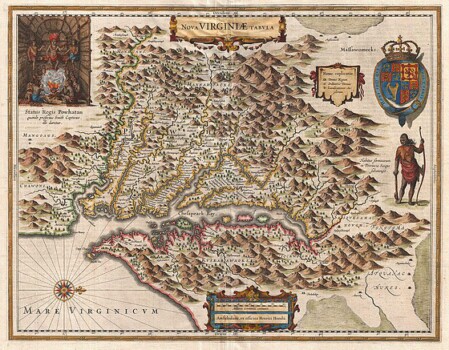
Henricus Hondius' 1630 map of Virginia
They received over £200,000 in investment in the first 13 years, but the colony struggled as its location was not the Mediterranean landscape and climate they expected. Instead, they were in a malarial area and they came close to bankruptcy. In 1620 Virginia had less than one thousand settlers and two years later the colony was almost wiped out by an Indian attack but by 1824 the crisis was over. The Company had gone bankrupt but was taken over by the Crown. What saved this Virginian colony was the resourceful leadership of John Smith and tobacco which was planted for the first time in 1617 and exported to England. By 1700 tobacco from Virginia had transformed the British economy with seventeen million pounds of tobacco imported annually. Revenue from tobacco was £421,000 between 1699 and 1701, 20% of all customs duties.
The Virginia Company
The London Company was reorganised as the Virginia Company in 1609 and Virginia became the wealthiest colony of those that had been established in the Americas. Newfoundland to the north had been established in 1610 and although it became a haven for the cod fishing fleets, it could not match Virginia’s wealth. Similarly, the Puritan settlers in the Massachusetts Bay area suffered from price rises, a depression in the cloth trade and from a succession of bad harvests. Their motivation was religion and the migration of Puritans was the largest migration in the 17th century. They established Boston and several other towns along the Massachusetts coast and by 1640 settlers were establishing towns up to 30 miles inland. These Puritans did not tolerate deviation from their beliefs and there were those who left the colony to establish settlements in which they could worship in their own way. Such a colony was Rhode Island which was established in 1636. Another colony founded to enable its settlers to worship in their own was Maryland, which was the result of Lord Baltimore persuading Charles I to grant him a charter to enable Catholics to have a refuge in the Americas. New Hampshire was also founded as a refuge in 1638. The Civil War stopped large scale migration to the Americas in the 17th century but following the restoration of Charles II in 1660, a number of grants were made to enable Carolina, New York, and New Jersey to be settled. For these colonies profit was the main motive for migration, although New Jersey became a refuge for Quakers. Pennsylvania was created as a result of Charles II granting a charter to William Penn who wanted a colony for his own supporters. By 1685 the desire for religious freedom and cheap land brought over 8,000 new colonists from the British Isles, Holland and the German Palatinate. With the foundation of Pennsylvania, England had a line of colonies from Newfoundland almost to Spanish Florida.
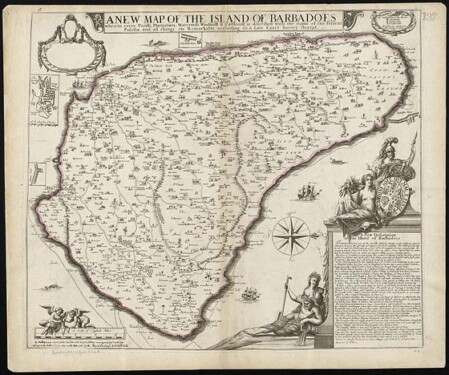
A Map of Barbados, 1686
Barbados
The success of Virginia led to a grant in 1627 of a charter to a group of merchants wishing to create a successful plantation colony on the Caribbean island of Barbados. Tobacco was planted but the planters could not compete with Virginia. What saved Barbados was the planting of sugar in 1643 and the new fashion of drinking of tea with sugar. Within 50 years sugar plantations covered 80% of the island. The economic success of sugar prompted other Caribbean islands to plant sugar and by 1660 St Kitts, Antigua, Nevis, Montserrat, and Jamaica had all become ‘sugar’ based economies.
The adoption of Slavery
The main difficulty the planters had with producing sugar, a labour-intensive crop, was indigenous diseases, especially malaria and yellow fever, which killed off thousands of the labour force which was recruited largely from the British Isles and consisted mainly of indentured servants. Preventative and curative medicine was quite primitive, and it was realised by the late 17th century that British labourers were not able to cope with the physical demands of working on the plantations. The indigenous people, the Caribbean Amerindians had been killed off and captured rebels from Cromwell’s campaigns and Irish labourers were not able to fill the demand for labourers. By the late 17th century, planters, out of economic necessity, were turning to imported negro slaves from west Africa to form their labour force, following the Spanish model.
The reasons for the establishment of colonies by those who ran the emigrant societies, by the government and the private companies changed little over the following centuries as did the reasons for settlers leaving their homes and family behind. The means of dealing with local people and the difficulties faced by new settlers also varied little, so that by 1750 the British Empire was largely based in North America where there were established settlements whilst elsewhere there were a smattering of trading posts usually located along rivers and coasts. The period after 1750 saw the British Empire become the largest empire the world had ever seen, and following the War of Independence with the American colonies, most colonies were in the east rather than the west but the main features and motives of empire remained much the same as they were for the very first colonies that were established along the American seaboard. The concept of settlement had been well established, and hundreds of thousands had made the journey across the Atlantic to establish new lives. The settlements provided for themselves as well as providing much needed goods for Britain. The motives for migration varied and the experiences challenged settlers in different ways, but the pattern had been set.
The impetus for migration was established as early as the 1630s and by 1689 English settlement in North America stretched from New Hampshire in the north to South Carolina in the south of the eastern seaboard with about 265,000 settlers whilst in the Caribbean settlements had been established on Barbados, the Leeward Islands and Jamaica. Out of a total population of around 145,000 at the end of the 17th century, 75% were black slaves, mainly employed on the sugar plantations. During the 18th century additional colonies were established, largely by war with European rivals, in the West Indies whilst in North America new colonies were established in Georgia, Florida, and in the north, Nova Scotia and Quebec. The British presence in Asia and Africa in comparison was minimal. It was not until after 1750 that the British acquired a significant presence in India following the defeat of the French in the Seven Years War.
In the 17th century about a million people migrated from the British Isles, of whom 70% were English, mostly going to Ireland and the Americas. The proportion of migrants to the then population of Britain was huge – between 1646 and 1700 the rate of migrants was 2.4 per thousand. This was the first mass movement of migrants from Britain and constituted a large part of the labour force leaving. The vast majority of these migrants were indentured servants who went to work in the tobacco and sugar business. They would have signed an indenture document by which their fare, and then their board and lodging in their new home were paid for, for a period of four to seven years and then they would be free. By the end of the century the proportion of indentured servants was falling and the numbers of free men who were skilled and semi-skilled workers rose steadily. Many of this new wave of migrants were merchants. Of the free men who travelled to Virginia between 1689 and 1815, 59% described themselves as merchants and mariners and 20% as professional people. The majority of emigrants at this time came from the London region although it is quite possible that they made their way to London from their homes further afield with the intention of migrating. By 1700 there was a decline in indentured servants going to work in the sugar and tobacco plantations as by then merchants were bringing to the Americas enslaved labour from West Africa.
The 18th Century
British migration in the 18th century was dominated by successive wars between Britain and France for control of the Americas and India. In the first half of the 18th century British pioneers were moving westwards into and beyond Pennsylvania so that the population of Pennsylvania increased from 24,000 to 85,000 – many from northern Ireland. They were also moving north towards the St Lawrence River. The Indian tribes were just swept away in their wake. The native Americans had a different concept of land ownership which was more based on communal ownership. They did not understand the complex documents or legal requirements and were often duped by unscrupulous land agents to sell their land with realising that they lost all of their hunting rights.
<
>
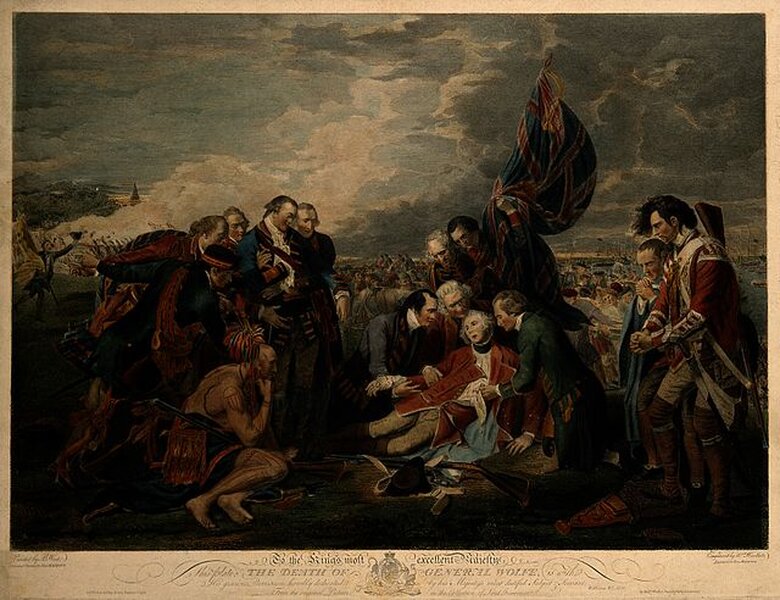
The Death of General Wolfe at Quebec
Engraving by W. Woollett, 1776, after B. West, the elder,
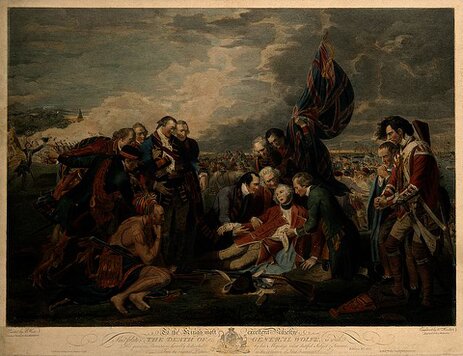
Engraving by W. Woollett, 1776, after B. West, the elder,
By 1750 British settlers had reached the Ohio River and clashed with French hunters and traders. There were frequent battles between British and French naval ships in the Caribbean, with Britain capturing the French port of Louisburg, gateway to Canada, in 1758 and then in 1759 Wolfe defeated a French army on the Plains of Abraham to take Quebec. The subsequent Treaty of Paris confirmed British control of Upper Canada and also the American interior.
Following the end of the Seven Years War between Britain and France in 1763, land speculators swarmed into the lands beyond the Appalachians with 30,000 English, 55,000 Irish and 40,000 Scottish migrants crossing the Atlantic. 2,000 migrants a year passed through the Shenandoah Valley in West Virginia as they made their way to the interior of Carolina enticed by tales of cheap land. With an economic recession back home in the woollen, silk and weaving industries and with a strike in Paisley amongst the silk weavers, a new life in the Americas was very appealing. They were joined by a mass flight from the Scottish Highlands and Western Isles as Scottish landowners demanded higher and higher rents.
Increasing migration from Ireland and Scotland
Migration from the British Isles in the 17th century had been dominated by the English but during the 18th and early 19th centuries, the numbers of migrants from Scotland and Ireland began to increase, settling mainly in the established colonies in North America and the West Indies. Seventy percent of all migrants arriving in America in the first 80 years of the 18th century were from Ireland and Scotland. Migration from the Lowlands of Scotland started around 1680 to East Jersey and South Carolina but was quite insignificant until after the Seven Years War with France, 1756-1763 when 30,000 migrants travelled to the American interior and Canada. A major cause of migration from the Lowlands was the financial crisis of the 1770s which brought depression to the textile industry. Helping them to migrate were some of the early emigration societies set up by tenant farmers to fund transportation and the purchase of land. Migration from the Highlands also began to increase after 1760 with up to 20,000 leaving, 20% of all British migrants at the time. They were leaving in response to the large changes in society at the time brought about by the impact of agricultural improvement and rent inflation. Many landowners were managing their estates differently, putting the need for profit before their historical duty to their tenants. The increase in sheep farming, the abolition of tenancy agreements and the commutation of rents in kind to cash all had a profound effect on Scottish small tenant farmers. Another factor was the rising population in the Highlands with land no longer being able to provide work for all, and with colonies being established in Nova Scotia and Halifax, migration to the Americas became an attractive proposition for young single men.
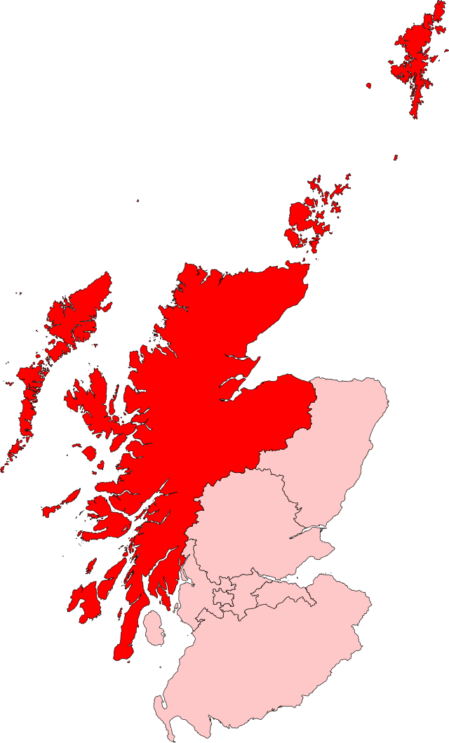
The HIghlands and Islands of Scotland
Irish migration in the 18th century followed a similar path to that from Scotland. The first of the large scale movements from Ireland began 1718-1720 following the granting of long term leases to Scottish migrants. Crop failure, cattle disease, the high cost of food and the slump in the linen industry all contributed to an increase in Irish migration. During the severe recession in the linen industry in the 1770-s a third of weavers were out of work and migration to the Americas did not seem to be such a risk especially as there were more and more trade links being established with the Americas.
The experiences of migrants in their new homes varied widely. Some expected to find established communities similar to what they had left behind with cultivated fields and laid out roads and were surprised to find a wilderness which they had to tame. Many could not cope with the loneliness, and the isolation from the nearest communities and returned home. For the majority they saw the opportunities to establish a new life and many moved on to better land and prospects elsewhere in the Americas.
Migrants were constantly on the move
A constant feature of migration is that settlers did not necessarily stay in the one place. They might seek to improve their prospects by moving to new land in the interior or they might move to a completely different colony or even continent. In some colonies new migrants found themselves needed to defend their homes against local native people whose land they had taken. Where relations with local people had broken down, settlers were expected to play a part in the defence of the colony and join the local militia.
The British Empire in the 17th and 18th centuries had been based in the western hemisphere and migration had been largely to these areas but following the American War of Independence, the British Empire began to develop in the eastern hemisphere with consequent migration although the Americas continued to be the favoured destination for most migrants with 12 million of the 20 million migrants heading to the newly formed United States of America. The ending of the War of Independence had produced a movement of loyalists from the American seaboard towards Upper Canada which would become an important destination for British migrants for the next hundred years.
By Peter Crowhurst, August 2024
Further reading:
Piers Brendon, The Decline and Fall of the British Empire, Vintage, 2008
John Darwin, Unfinished Empire, Penguin, 2012
Marjory Harper and Stephen Constantine, Migration and Empire, Oxford, 2014
Lawrence James, The Rise and Fall of the British Empire, Abacus, 1998
Maldwyn A. Jones, The Limits of Liberty, Oxford, 1982
P.J.Marshall, The Eighteenth Century, Oxford, 1998