


Welcome to 'British Empire 1815-1914'
Welcome to this website on Britain 1815-1914, Britain’s Imperial Century.
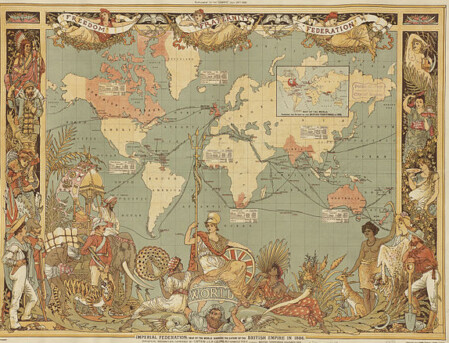
In 1901, the year in which Queen Victoria died, the British Empire was spread out over a quarter of the world’s surface and contained a fifth of its people. It had a huge impact not just on Britain but more importantly on those territories that were part of the British Empire. The world we inhabit has been shaped by that Empire and if we are to fully understand our world and its people , understanding the British Empire is crucial to this understanding. It is my hope that this website can go some way to foster a greater understanding of the British Empire.
Why did Britain acquire an Empire? Who benefited from it? What kind of support did the Empire enjoy in Britain? How were the people of empire ruled and what kind of rule was it? Was there an ideology of empire? What was the cultural legacy of imperialism? These are all questions still discussed by historians and can provoke heated discussion, and are topics which are covered on this website.
Who is this website for?
I have produced this website for anyone who is interested in knowing more about the British Empire, especially during those years when it reached its greatest size and degree of influence - the Victorian period. Whether you are coming to the empire for the first time, or you are a casual reader, or you are a first year undergraduate student, I hope there will be something here for you.
What does the website offer?
This website has information about the growth of the British Empire from the time of the Napoleonic Wars until the outbreak of World War One. There are introductory essays, then sections on some of the Key Questions that engage historians and the public, and essays on the main Turning Points and Profiles of some of those who helped make the British Empire. The British Empire was built on violence and there is a section on Conflict which covers some of the wars fought to expand the British Empire as well as coverage of examples of resistance to the Empire. There is a Reference Section with glossaries of colonial wars, and the territories of the British Empire and also suggestions for further reading, both fiction and non-fiction. If you are looking for something which is not here or you have suggestions as to what might be included, please contact me using the form below.
Where should I begin?
If you are new to the study of the British Empire you may want to read What was the British Empire? followed by Britain’s Imperial Century. These essays discuss the idea of empire and how and why the British Empire grew in the 19th century. If you want to know a little about the background of the establishment of the British Empire, you may want to read ‘An Outline History of the British Empire'. If you are interested in understanding the importance of studying the British Empire you should read Why is it important to study the British Empire?
Who am I?
My name is Peter Crowhurst and I was born in Winchester, Hampshire in 1949. I was brought up in Winchester and Malta, and attended secondary school at Peter Symonds in Winchester. I subsequently attended the University of Kent, and Bognor Regis Teacher Training College before starting my teaching career in a Boys Secondary School in Hove. I then taught English for a couple of years in a West German Gymnasium in Solingen, before returning to England and taking up a position as a History teacher (and subsequently Head of History) at Steyning Grammar School, West Sussex, England, where I taught all ages and periods of British and World History up to 'A' Level. During my time at Steyning Grammar School, I undertook a year's exchange with a teacher from Melville School, Hamilton, New Zealand.
I have taught aspects of the British Empire throughout my career and also introduced a British Empire topic into the 'A' Level curriculum. Since retirement, I have developed further my interest in the British Empire. I am committed to developing a better understanding of the British Empire ‘warts and all’ and in particular showing how that although the British Empire was based on violence, oppressed subject peoples and destroyed native cultures, this was not the whole story. The introduction of schools, the making available of medicines, the building of roads and railways, were all also a part of British colonialism.
Citing this website
You are very welcome to cite pages on this website, using my name. If any details that you require for a citation are missing, please contact me using the Contact Form below.
Acknowledgements
Every effort has been made to ensure that images used on this website, British Empire 1815-1914, are part of the collection of the editor, are part of other collections which have granted permission for British Empire 1815-1914 to use their material, are licensed under the Creative Commons Attribution-Share Alike licence, or are in the Public Domain. The website British Empire 1815-1914 apologies for any errors or omissions, and would welcome these being brought to its attention.
You can contact me using the form below.
Useful Introductory Pages