




The Occupation of Egypt 1882-1922
Wolseley's Plan
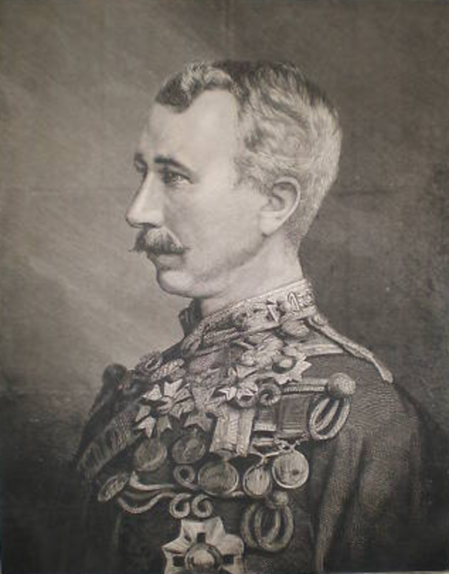
On the 7th September, 1882, General Wolseley, the most successful colonial soldier of the 19th century, wrote a letter to his wife, Louisa, from the banks of the Suez Canal in which he said: ‘Before this reaches you the news of our fight will have reached you with it’s disquietening ‘’butchers’ bill’. He went on to say that: I wish I could see you for five minutes but then I know you would say, ”Don’t risk anything”. Well, the die is cast and I must stand by it. I have resolved to fight Arabi (Urabi Pasha) next Tuesday or Wednesday. If my plan succeeds it will be the end of Arabi. All my plan depends on the infantry being steady in the dark. If they are not steady, I may fail altogether.’ ‘I would rather leave my old bones ‘here ‘than go home and be jeered at.’
Wolseley was in Egypt, in charge of an army of over 31,000, to defeat the nationalist forces of Urabi Pasha, who in a coup d’etat in September 1881, had taken control of the Egyptian army which at the time of Wolseley’s letter was based in a fortified camp at Tel-el-Kebir.
A Night March
Wolseley’s forces had occupied the Suez Canal and had gone ashore at Ismailia on 18 August, 1882. Four weeks later, on the night of 13 September, having moved slowly across the desert, Wolseley’s army was to make a dangerous but bold night march to attack Tel-el-Kebir at dawn and overrun the Egyptian forces. He had told his generals the night before the battle of his tactics but he had decided several weeks beforehand what he was going to do but decided to keep his plans secret for fear of the news getting out. Night marches could very easily go wrong and were rarely attempted. He was well aware of the dangers of a night attack and had prepared his wife for bad news. If the night march went wrong and the Egyptian forces were alerted to the attack, he knew his reputation would be shredded by the press.
General Wolseley
Cairo Taken
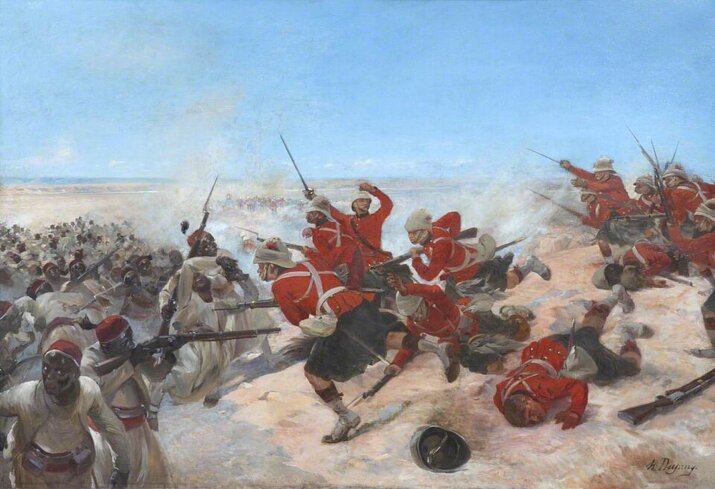
In the event, Urabi’s forces were taken completely by surprise, and their fort was taken with relatively few losses on the British side. Wolseley then marched on Cairo, several day’s march to the south and took the Egyptian capital without further loss. The British Prime Minister, William Gladstone, an opponent of imperialism in the preceding election, was embarrassed by what had happened but claimed that Egypt had to be rescued from self-destruction and that Britain would supervise the rejuvenation of Egypt. A cadre of British civil servants under the supervision of Sir Evelyn Baring (later Lord Cromer) was established in Cairo to oversee the Egyptian administration and to reform the army. Gladstone claimed that the British presence in Egypt would be temporary however this statement of intent would be repeated sixty-six times by successive British governments as Egypt became effectively a British protectorate.
Egypt under the British
The decision by the British government to invade and then take over Egypt had been hotly debated in Britain. To effectively annex a territory was something that governments usually did as a last resort. Where annexation took place, British interests were usually already established independently of government. British financiers and entrepreneurs did not need the support of the British government to trade or invest in foreign territories, and the government did not seek annexation unless the established British interests were threatened in some way, that could not be dealt with at the local level.
Annexations were costly and not popular
The annexation of a territory and the setting up of a British administration was costly and not something that governments chose to do unless it was absolutely necessary. For most of the 19th century until about 1870, there had been few annexations of territory, but the changing geo-political situation after 1870, when new economically powerful nations began to rival Britain, resulted in a huge expansion of the British Empire.
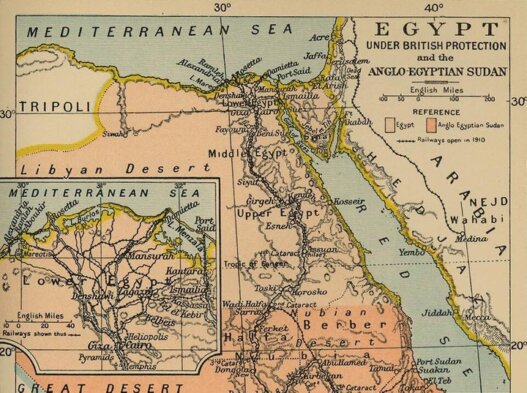
British investment in Egypt had grown enormously in the 19th century and the building of the Suez Canal was to introduce a new and cheaper trade route to India and the east, areas of crucial importance to the British economy. British interest in Egypt became so important that it became necessary to ensure that Egypt was run in a way that British economic and strategic interests were not threatened.
At the time of the Battle of Tel-el-Kebir, Egypt seemed to be on the verge of becoming a modern state integrated into the global economy. This was due to the work of Muhammad Ali and his successors who sought to create a territory that was sovereign and that had a thriving economy, however the strategic position of Egypt in the Eastern Mediterranean was to play an important part in its history. In July 1798, Napoleon had landed a military force on Egyptian soil, and then taken Alexandria, the port on the Mediterranean before marching on Cairo. It was a short-lived adventure, but it served to remind British officials of the possible threat posed by the French to the eastern Mediterranean. With the growing economic importance of India to the British economy after 1840 when the UK’s surplus in trade with India helped cover its trade deficit with the US and the rest of Europe, all routes to India had to be protected whether they were trade routes or routes that could be used by an enemy to threaten India.
By 1882 what had been a crisis over Egypt’s financial position developed into something far more serious as the British and the French began to consider the strategic position of the Suez Canal and who was running Egypt. With the area assuming far more importance to Britain, the question of who was running the government became an important consideration. Although the Khedive Tewfiq was nominally in charge, officials in the Foreign Office in London regarded Urabi Pasha as the person who was behind the unrest and the rising swell of nationalist feeling.
Egypt was nominally a province within the Ottoman empire with the Egyptian leader, the Khedive, appointed by the Sultan of Turkey. It became the aim of successive Khedives to establish relative independence from the Sultan and develop a modern state. From 1820 Muhammad Ali and his successors transformed the Egyptian province by promoting the diversification of the economy and its industrial growth to enable Egypt to be incorporated into a global economy, principally by supplying Europe with raw materials, mainly cotton, and consuming manufactured goods. With European
investment (largely through the purchase of Egyptian bonds) and the influx of
foreigners with their knowledge and skills, railways were built, shipbuilding and
new irrigation schemes introduced, cotton plantations were established, along
with new schools and universities.
The surrender of Urabi Pasha
The export of cotton became the bedrock of the economy
with 60% of the land given over to cotton, much of it to be exported to
Britain. These changes were accompanied by a huge increase in the number of
foreign residents from around 8,000 in 1838 to 90,000 in 1881. There were
Britons, French, Italians from western Europe as well as Armenians, Jews,
Greeks, many benefitting from financial
privileges and with inflated salaries
The importance of the Suez Canal
Much of the investment had been used to build the Suez
Canal which had opened in 1869. Khedive Ismail (Khedive 1863-1879), had taken a
40% share in the canal with most of the rest of the shares owned by the French.
When the canal was built, there was not a lot of British interest in the canal,
and most British trade with India and the east continued to go via the Cape
route. As the canal was improved and deepened, more British trade was routed
through the canal, and by 1880 it was seen as crucial to British trade. When
Khedive Ismail announced in 1875 that Egypt was bankrupt and a year later sold
off all the shares in the Canal Company that he owned, the British Prime
Minster, Disraeli was quick to buy up the 44% of shares in the company.
The sale of Ismail’s shares in the Suez Canal Company
was insufficient to keep Egypt financially solvent. Constant borrowing at high
interest rates, much of it for public works and economic improvements brought
bankruptcy in 1876. By 1879, Egypt’s total debt amounted to £100 million (£3.3
million in 1863) whereas her exports only amounted to £13 million.
With commercial confidence in the country shattered,
the investments of firms and individuals of many nationalities were threatened.
A body called the ‘Caisse de la Dette Publique’ was created by the main
European powers to oversee Egypt’s budget, followed quickly by the
establishment of the Dual Control, a body established by Britain and France
which consisted of two controllers, one from each country, The Treasury,
customs, post offices, telegraphs, railways ports and even museums came under
the control of the British and French controllers who imposed strict financial
controls and economies, in order to protect foreign investments. Two thirds of Egypt’s’
revenues were used to repay debts and more than 1,300 foreign officials were
brought in, adding to the resentment felt by the Egyptian people at the impact
of the decisions taken by the Dual Control, and the loss of sovereignty and
economies increased the resentment felt by the Egyptian people. Pressure was
brought by the British and the French to persuade the Sultan in Constantinople
to replace the Khedive, and he was replaced by his son, Tewfiq in 1879 however
he had little impact.
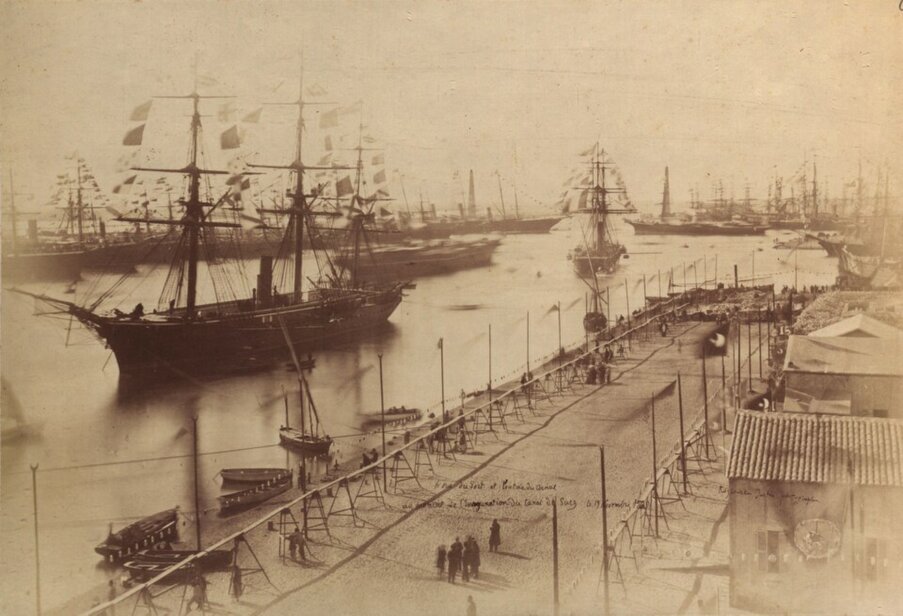
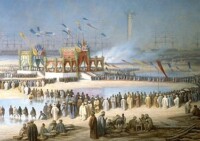
The Opening of the Suez Canal in September 1869
A Military Coup
In September 1881, there was a revolt in the military at the state of the country. It was led by the four native born colonels in the army who called for ‘Egypt for the Egyptians’ and had the support of elite groups, intellectuals and the rural population which had suffered with the creation of large estates for the cotton industry and the loss of land for small farms. The revolt was led by Urabi Pasha, one of the colonels who made himself Minister of War although Tewfiq remained Khedive but with little power. The economy was being run by foreign officials, and the army was controlled by Urabi.
The discontent that was simmering among many groups in Egypt was causing concern in London and Paris, with officials concerned about the security of the Suez Canal and whether investors in Egypt would ever be repaid. Up to the September revolt, the influence of the European powers, was quite informal with no direct control from London of the governance of the country, but as the internal situation worsened, and concerns about the Suez Canal in particular increased, what had been informal control was to become much more formal.
Although British commercial interests favoured the building of the Suez Canal, British trade through the canal was quite limited at first because of the cost of using the canal and its lack of depth. By 1882 though, with improvements made, 80% of shipping through the canal was British, which amounted to 13% of total British trade. The Canal was becoming important not just to British trade, but also for strategic reasons. By 188o the growth of the Russian Empire was such that it threatened India, Britain’s most important colony. British policy for the defence of India against the perceived Russian threat was a) to ensure that the Eastern Mediterranean was controlled by Britain or its allies, which included Turkey, a weak power that controlled the entrance from the Black Sea to the Mediterranean, and also b) that the lands on the Indian frontier were friendly to Britain.
A war between Russia and Turkey in 1876 had demonstrated the weakness of Turkey and although Britain managed to ensure that Turkey retained control of the Dardanelles and also gained control of Cyprus to be used as a naval base, Turkey could not be relied upon to keep Russia out of the Mediterranean. Moreover, the instability of Egypt and the opening of the Suez Canal weakened the British hold over the routes to India. To compensate for this, Britain increased the number of military consuls operating in Armenia and also began to send spies into central Asia to monitor Russian movements. Naval and army bases were established on Cyprus and 177,000 shares (out of 400,000) were bought in the Suez Canal Company. It was also British policy to develop a ring of client states in the Persian Gulf and over the following 20 years treaties were signed with the rulers of Balichistan, Persia, the Northwest frontier and Upper Burmah.

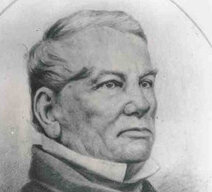
Urabi Pasha
By 1882 what had been a crisis over Egypt’s financial position developed into something far more serious as the British and the French began to consider the strategic position of the Suez Canal and who was running Egypt. With the area assuming far more importance to Britain, the question of who was running the government became an important consideration. Although the Khedive Tewfiq was nominally in charge, officials in the Foreign Office in London regarded Urabi Pasha as the person who was behind the unrest and the rising swell of nationalist feeling.
In January 1882 the British and French sent a joint note to the Khedive, declaring their recognition of his authority however popular support for Urabi was overwhelming. He had the support of the Muslim and Coptic religious leaders, the elite of Egyptian society and support from the rural classes. A petition containing 90,000 signatures expressed support for Egyptian independence and at a meeting in Alexandria attended by up to 10,000 people, the Khedive and the great powers were denounced.
A naval force sent by the British
In an attempt to put pressure on the nationalists, in May 1882, the British and the French sent a naval force to Alexandria consisting of six ships. If this was supposed to threaten the population of Alexandria it had the opposite effect for on 11 June disturbances broke out which eventually led to the deaths of 50 Europeans and 170 Egyptians. This was seen in the British parliament as the first step towards anarchy and shook the money markets in Paris and London. There was much concern amongst the business community as huge losses were predicted. There were demands for action from parliamentarians and the business community. The French parliament discussed the situation and decided against becoming actively involved. It was now up to Britain if any action were to be taken.
In Alexandria, Urabi had improved the city’s defences with modern cannon and when Admiral Seymour, commanding officer of the British ships, demanded the removal of the cannon, Urabi refused. Seymour was then given authorisation by the British parliament to destroy the cannon. Alexandria was bombarded by the British ships and a few days later, on 11 July, landing parties of sailors and marines entered Alexandria by which time Urabi’s soldiers had departed.
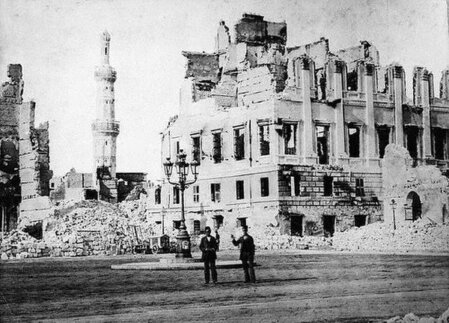
Homes in Alexandria in ruins after the British bombardment
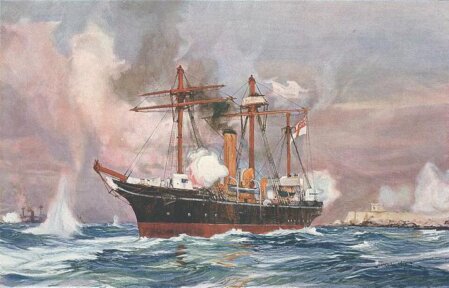
The British Bombardment of Alexandria
Gladstone defended the actions of the British saying that law and order had broken down completely in Egypt and that the British sailors and marines would restore order and install a new administration. During August two British armies, one force of 7,000 men from India and another force of 24,000 men from Britain, under the command of General Wolseley, were sent to Egypt to take control of the country and establish a new regime.
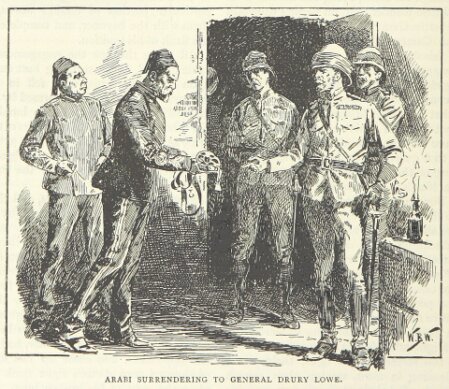
The Suez Canal was occupied by the British army and on 18 August, the men went ashore at Ismailia. From there the army moved slowly across desert towards Urabi’s army, in a fortified encampment at Tel-el-Kebir. On the night of the 13 September, the British army embarked on a night march to arrive at Tel-el-Kebir at dawn. The British force had arrived unheard and unseen and Urabi’s forces were taken completely by surprise. Urabi himself was captured.
Following the capture of the fort and the defeat of Urabi’s army, Wolseley led his forces towards Cairo which was taken without a fight. Gladstone now claimed that the British would rescue Egypt from self-destruction and supervise her regeneration. Sir Evelyn Baring was appointed to oversee Egypt’s administration. Supported by a large number of civil servants, Baring’s job was to restore Egypt’s finances and reform the army. Outwardly Egypt was ruled by Khedive Tewfiq but in reality, the country was run by Baring and British civil servants. This occupation was supposed to be temporary but it lasted for another fifty years. The Suez Canal and the cotton industry was too important to Britain. In 1881 2,250 of the vessels that sailed through the canal out of a total of 2,727 were British.
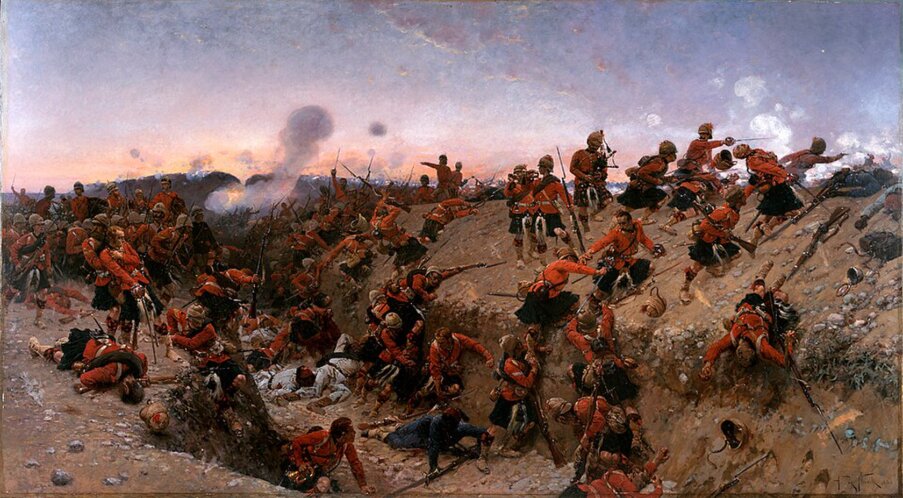
The Battle of Tel-el-Kebir
A good example of informal empire
Egypt was a very good example of how and why Britain
replaced informal influence in a country to formal control. Despite over 60
statements over the years by British governments that the occupation was
temporary to deal with disorder and restore the Egyptian Khedive to full
control, it was always Baring’s view that a rapid withdrawal was incompatible
with the need to provide stability. It was also the view of British Military
and Naval Intelligence that the security of imperial routes needed direct
control over the Egyptian government. Despite the utterances of successive
governments Britain retained her control over Egypt and the canal. Good
government was regarded as more important than self-government so that
eventually British civil servants were placed in all government departments as
advisers. In 1892 France signed a defensive agreement with Russia which along
with the continued weakness of Turkey seemed to justify the decisions taken in
1882.
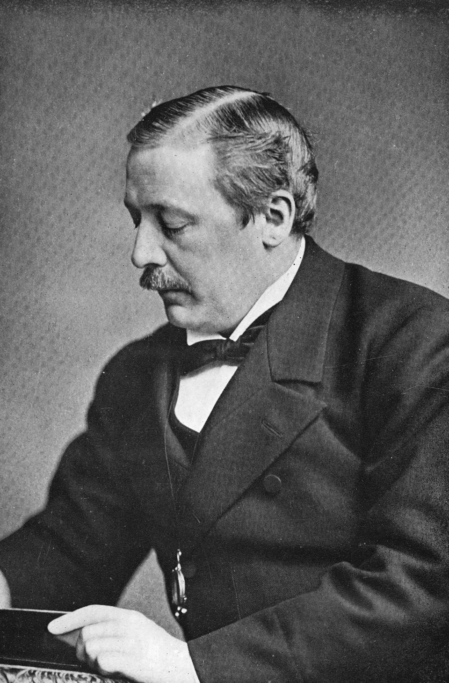
Sir Evelyn Baring (Lord Cromer)
Khedive Tewfiq learnt to appoint Cabinet Ministers whom he knew would defer to the British advisers and the army was reformed under British officers. British forces were based permanently in Egypt and a British naval base was established at Alexandria. The cost of the British forces was borne by the Egyptian Treasury. This system whereby Egyptians supposedly ran their own country, but Egyptian Ministers deferred to British advisers was known as ‘The Veiled Protectorate’.
Baring concentrated on the measures necessary to return Egypt to solvency. To do this he worked on increasing agricultural exports, predominantly cotton, supporting essential public works schemes, raising government revenue and also attracting foreign investment. Cotton had long been the main export but from the 1890s, growth of the cotton industry increased even more rapidly. This was done by increasing the land under cultivation and improving irrigation.
The Egyptian economy was strongly linked to Britain
Irrigation engineers were brought to Egypt from India, and agricultural lands that had belonged to the Khedives was sold off, mainly to existing owners of large estates. Peasants could not compete with the large landowners so focused their efforts on basic staple crops like maize. The profitability of cotton pushed land prices and rents up so that many small landowners had to sell their holdings and become agricultural labourers, and part of the large reservoir of cheap labour for the cotton fields owned by the large landowners.
Changes in industry had a similar impact on the rural classes. All state owned industries that had been put under state control by the Khedives were sold off to pay off the national debt. Baring did not allow the creation of any industry which required protection. New industries linked to the cotton industry incurred an 8% tax which happened to be the same amount of tax as on textiles imported from Britain.
The Egyptian economy continued to be strongly linked to Britain. By the 1890s, 63% of total exports from Egypt were to Britian and 38% of imports were from Britain. The consequence of Baring’s administration were that by 1909 total trade with Britain amounted to £E13 million which was double that in the mid1880s and because of the increase in land devoted to cotton production, the areas given over to other export crops (onions, rice, beans, barley and sugar) declined during Baring’s administration.
Egypt had become under Baring’s rule effectively a single crop economy with the rural population increasingly landless. Local industry was to decline as trade and commerce came under the control of foreigners. Baring, who disliked Islam and Sharia law, Europeanised Egyptian law. He also did nothing to improve the education of the rural population as he refused to allow government for the building of new schools. Foreign institutions, which taught English, grew so that there would be an educated elite who increasingly adopted western culture. New western style department stores began to become popular with western fashions in clothing and furniture.
The exile of Urabi Pasha to Ceylon had helped quell nationalist sentiment, until the 1890s when a new nationalist movement began to develop, with the encouragement of Tewfig’s successor, Khedive Abbas II, although when Abbas tried to exert more influence over the choice of his Ministers he was threatened with exile. When Baring (now Lord Cromer) retired in 1907, to be replaced with Sir Eldon Gorst, he was told to initiate a new policy of friendship with the Khedive in order to quell increasing nationalist feeling. Gorst was replaced in 1911 by Lord Kitchener who opened talks with the nationalists, but war intervened and Egypt continued to have a British administration, becoming a British protectorate in 1915 before achieving independence in 1922.
By Peter Crowhurst
June, 2026
Further Reading:
Afaf Lutfi Al-Sayyid-Marsot The British Occupation of Egypt in The Nineteenth Century, Ed Porter Andrew, Oxford, 1999
Brendon, Piers, The Decline and Fall of the British Empire, Vintage Books, 2008
Hyam, Ronald, Britain's Imperial Century, Palgrave, 2002
James, Lawrence, The Rise and Fall of the British Empire, Abacus, 1998
Porter, Bernard, The Lion's Share, A Short History of British Imperialism, Longman, 1975