

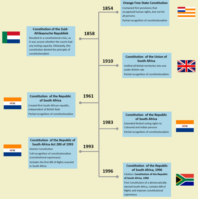


Evelyn Baring, 1st Earl of Cromer
Evelyn Baring was a British administrator and diplomat whose rule in Egypt as British agent and consul-general considerably influenced Egypt’s development towards a modern state in the late 19th century at a time when Egyptian finance and governance was effectively controlled by Britain.
He was born on February 26, 1841, at Cromer Hall, Norfolk, the ninth son of Henry Baring and his wife Celia Anne. Henry was the third son of Sir Francis Baring, the founder of Barings Bank. When Hanry died in 1848, Evelyn, aged seven, was sent to boarding school. At fourteen he entered the Military Academy at Woolwich from which he graduated at 17. In 1858, at the age of seventeen, Evelyn received a commission in the Royal Artillery and was posted to Corfu, a British protectorate, where he was responsible for a battery.
It was in Corfu that Evelyn became aware of his inadequate education and began to educate himself in the Greek and Italian languages. He returned to Corfu to become an aide to the governor, Sir Henry Storks. Baring then followed Storks to Malta and then to Jamaica, where Storks headed the official inquiry into the Morant Bay rebellion. In 1868 Baring was selected to attend the Army’s Staff College, graduating in 1869. He worked for two years at the War Office and was promoted to second captain.
In 1872, Baring was offered the position of private secretary by his cousin Lord Northbrook, who had just been named Viceroy of India. It was during this time that he found that he made a far better administrator than a soldier. He was self-assured and seemed to have a natural ability to command although his colleague found him overbearing and his subordinates found him patronizing. He referred to the local people as ‘subject races’ and it was whilst serving in India that he changed his opinions on native peoples believing native rulers were too often tyrannical. He determined that strong rule accompanied by reform programmes was the only way to help peasant peoples, and sound financial systems was the basis of reform. When Northbrook returned to England in 1876 Baring also returned, and married Ethel Errington, whom he had met in Corfu.
In 1877, following the financial collapse in Egypt, Baring was sent to Egypt for the first time as a representative of the British holders of Egyptian bonds, on the Egyptian Public Debt Commission which was supposed to help the ruler of Egypt, Khedive Ismail Pasha out of his financial difficulties. Baring helped to establish a Commission of Inquiry into the state of Egypt’s finances, but when the Commission’s advice was rejected by Ismail, Baring returned to England. Baring returned to Egypt in 1879, following the overthrow of Ismail, as part of the system of Dual Control whereby the French and British each nominated a Controller to oversee Egypt’s finances. This opened the way for what became foreign control of Egypt’s finances and governance and Egypt becoming in effect a territory within the British Empire.
Baring remained in Egypt for three years returning to England in 1882 but after the occupation of Egypt that followed the defeat of Urabi’s forces at Tel-el-Kebir by General Wolseley, Baring was sent back to Egypt by the Gladstone government. Gladstone was determined that the British position in Egypt be just temporary and that there would be no annexation as this would create a heavy financial and military burden for the British. However, Gladstone knew that the British could not withdraw without having brought stability to the country and instituted a programme of financial reform. Lord Dufferin was sent to Egypt to produce a report on the situation. It advised political reform followed by an early withdrawal, but it would be no easy thing to impose administrative reforms on the Egyptian people. Baring retuned to Egypt as the British agent and consul general with plenipotentiary powers.
Consul-General
Arriving in Egypt in 1883, Baring quickly determined that an early withdrawal was incompatible with administrative reform. His first act was to accept and implement the findings of the Dufferin Report which called for the need for British supervision of reform, and for the British interest in the Suez Canal to be maintained as a priority. Baring quickly came to the conclusion that he Egyptian administration under the Khedive was inefficient if not incompetent and that if reforms were to be long lasting and transformative, time would be needed. He instituted a form of government called the Veiled Protectorate, by which British administrators, many from India, were placed in key positions as advisers to the Egyptian government. The khedive Tewfiq, was weak and deferred to the British., so that Egyptian rule was a façade with British administrators holding the real power. Under this system Egypt was made financially solvent by 1887. Baring had the support of the Foreign Office who usually deferred to his judgement on most matters. It was a case of the man on the spot being the decision maker rather than the colonial government.
Sudan
By 1883, the year of Baring's arrival as consul-general, the Mahdist revolt in the Sudan was in full swing. Sudan had been an Egyptian province since the 1820s, and was valued for its water, as a source of slaves and as a symbol of Egyptian power but the Egyptian hold over Sudan was fragile. By 1883 the Egyptian army ln Sudan, led by an Englishman Colonel Hicks, numbered nearly forty thousand, but struggled to keep a lid on the unrest and collect the taxes imposed on the population. There had been a number of foreign Governors including General Gordon, who had been involved in the suppression of slavery. In November 1883, Hicks’ army was ambushed by the forces of the Mahdi and was destroyed with much of its armaments captured. This latest revolt against Egyptian rule had begun in 1881, led by Muhammad Ahmad, a holy man who called himself the Mahdi and saw as his mission the purification of Islam, and the removal of all foreign armies.
Baring, like the two governments he sought to guide, had to decide whether the Sudan should be retained and if so, how. There can be no doubt that this episode was the most painful and embarrassing of Baring's entire career. In later life he liked to stress that his own preference had been to concentrate on Egypt's financial recovery, which futile expenditure on the Sudanese struggle could only delay and perhaps wreck. But he also knew that to lose the Sudan would be a staggering blow to the khedival regime and threaten its partnership with Britain. Hence his advice to London, and even his attitude to the controversial matter of Gordon's appointment as governor-general with a mandate to save the Sudan, were marked by the vacillation and uncertainty which he liked to condemn in others. Having recommended the evacuation of the Sudan and opposed Gordon's dispatch, he changed his mind and enthusiastically endorsed Gordon's mission.
When Gordon was besieged, Baring pressed the Gladstone government to send a relief expedition. Perhaps in reaction to his own involvement in an affair of such public horror and shame, Baring became deeply disillusioned (in a way later echoed in his protégé Milner) with the defects of party government and especially with Gladstone’s personally. He came to loathe what he saw as Gladstone's confident knowledge and his oratorical powers which gave it full rein. There was scarcely a subject, he remarked later, which did not attract Gladstone's attention and on which he did not seem impelled 'to form decided opinions … and to let the world know what those opinions were', regardless of whether they were built on a foundation of knowledge.

General Gordon's Last Stand'.
He did not think it was for the government to be involved in the provision of education. He also believed education would encourage nationalist ideas amongst the population, and he was against women joining the professions, He claimed that male doctors were the most rusted medical practitioners.
Having persuaded the Egyptian government to abandon Sudan, Baring was free to focus on restoring the country’s finances. He cut public spending and concentrated on doing all he could to develop the cotton industry and other agricultural projects. More land was brought under irrigation constructed by engineers who had been brought to Egypt from India but increased the country’s dependence on cash crops grown for export whilst local agriculture suffered and the peasant population became effectively a labour force for the large cotton estates. The Khedive Tewfiq meekly acquiesced with the transformation of the Egyptian economy, whilst there was little political opposition amongst the population.
Spending on education was cut as part of Baring’s reforms. There was more focus on vocational training and tuition fees were introduced at existing primary schools which reduced the possibility of attending schools for many Egyptians.
By the 1890s the prevailing thinking on race had developed
and reflected the ideas of the social Darwinists led by Herbert Spencer who
held that the British were a superior race and their mission was to civilise
native peoples who were not capable of economic and political development
without the help of the British. Baring’s ideas of the Egyptian people mirrored
the ideas of Spencer in that it would take a long time to get to where the
western world was. Baring also believed that the Islamic world was inferior to
the Western world, and especially in the treatment of women.
By 1887 Egyptian finances had been put on a sounder
footing and there was increased prosperity amongst the population. For these
reasons and also because of the weak position of the Khedive there was little
call for the British to leave Egypt. In 1892 Tewfiq died and Abbas Hilmi II
succeeded him. The new Khedive initially encouraged the nationalist movement
and challenged the existence of the Veiled Protectorate but once Baring had
threatened him with removal from office, nationalist groups went underground and
continued to operate secretly.
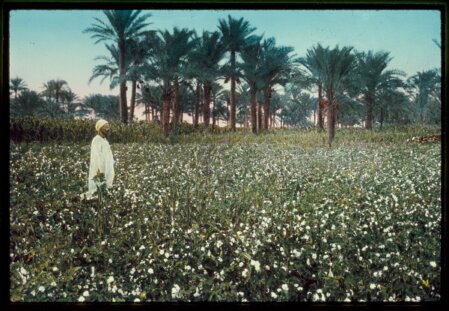
Cotton became the main export under Baring
Dinshwai
In 1907, in an incident which led to severe reprisals, and subsequent protests both in England and in Egypt, Baring’s position became weaker. The incident had been triggered by the death of a British officer in the village of Dinshwai followed by severe sentences being passed on the Egyptians involved. The incident was brought about by the arrival of five British officers in the village intent on shooting pigeons. The pigeons were valued by the villagers for food who protested against the shooting party. When a fire broke out the villagers blamed it on the firearms of the British and a scuffle began in which a British office was killed.
Harsh sentences were designed to teach a lesson
52 men were arrested and tried under a law which allowed crimes against British officials and servicemen to be tried more quickly and with more severe punishment. The trial of the men was held ten days later, and the defendants had just 34 minutes in total to testify. Four men were found guilty of premediated murder which carried the death sentence. A further 12 men were found guilty and sentenced to various prison terms and eight men wee sentenced to be whipped 50 times. One of the men condemned to die was the owner of the pigeons and he was hanged outside his own house.
The harsh punishments served to increase opposition to the British presence in Egypt, with many Egyptian leaders expressing the view that co-operation with the British was now unacceptable. In 1910 one of the five judges in the case, Ghali, was shot dead by a 23year old student who had just returned from Britain -the first assignation of a senior statesman for 100 years in Egypt. The Dinshwai incident was a turning point and marked the beginning of the end for the British occupation of Egypt.