



The 1820 Settlers in the Eastern Cape
The Chapman sets sail
On the 3rd December 1819, a Royal navy transport ship , the Chapman, left her mooring in Gravesend with 68 families and 11 single men aboard as passengers bound for South Africa. The ship had to wait for the prevailing winds before it could enter the Channel waters. It was followed closely by the Nautilus, with about 60 men, which was supposed to travel with the Chapman. These two ships were the advance party of over 60 such ships, all full of would be settlers hoping to make a new life in the recently acquired British colony of Cape Province, centred on the port of Cape Town. Their arrival in South Africa would begin a period in which the British tried to consolidate their presence in the Western Cape and begin to develop a settler society that was distinctly British in character. The settlers, knowing very little of the place that would be their future home hoped to create a piece of English country life in which their place in society was higher than their position from whence they came.

Arriving in Algoa Bay
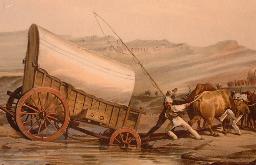
The Chapman arrived in Algoa Bay, later Port Elizabeth, on 10th April, having stopped at the Cape Verde Islands en-route to stock up on fresh fruit, vegetables and meat to supplement their daily diet of salt beef or pork, ship’s biscuit and oatmeal, cocoa and sugar. The ship had also stopped at Table Bay to be welcomed by the Deputy Colonial Secretary, Henry Ellis. The vista of Table Bay would have impressed the ship’s company but all they could see on arrival at Algoa Bay was a tented town of 2,000 tents which became their home until it was time to be taken by ox and cart to their final destination in the Grahamstown area. Along the way the settlers encountered the Boers, who had lived in the area between Cape Town since the Dutch arrived in the 17th century. This final journey through very rugged countryside of thick bush with deep river valleys took about two weeks and when these prospective settlers arrived at ‘their’ land and were deposited with their belongings and tents they were by themselves and left to build a home and transform the land so that they could grow crops which would make them a living.
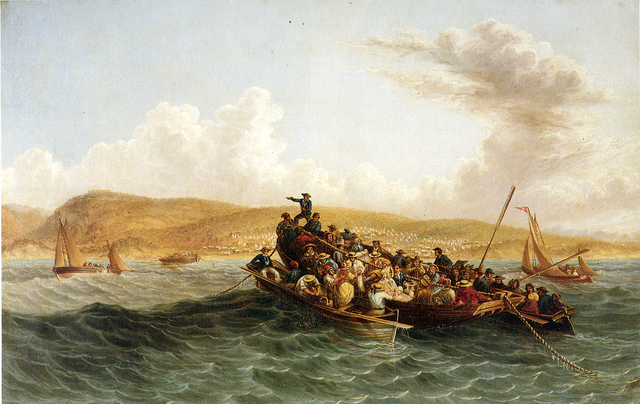
British Settlers arrive in Algoa Bay, 1820, by Thomas Baines
Sixty ships arrive in total
Over the following years they encountered drought, floods and diseased crops and the deposits they had paid were quickly used up to pay for new seed, saplings and more appropriate tools and machinery with which to tame the hard stony ground. Many of these settlers were totally out of their depth as farmers, and could not adapt to the harsh climate and conditions, and abandoned their land for the comparable safety and comfort of Grahamstown and Algoa Bay.
The Chapman and Nautilus were followed by a further 60 ships, all full of settlers with the same hopes and expectations, and all of whom were to have similar experiences once they arrived at their final destinations. They were though to be an important part in the British consolidation of the defence of the eastern border of the Western Cape, and establishing commercial farming that could contribute to the economy of the Cape Province. By the 1820s, the British had gained complete formal control of the Cape from the Dutch and wanted to strengthen their hold over the areas particularly on the eastern frontier which was contested between the British and the Xhosa people with whom there had already been one war in 1811. With a firm grip on the Cape area the British could introduce a number of social, economic and judicial reforms which changed the character of the area and alienated the existing Dutch population.

HMS Nautilus
The Dutch presence
There had been a Dutch presence in the Cape since the arrival in 1652 of Jan van Riebeck aboard the Drommedaris, the flagship of a small fleet of three Dutch ships charged by the Dutch East India company with laying out a vegetable garden, securing a source fresh water and constructing a fort below Table Mountain. He was further ordered to remain at peace with the local people and trade with them for cattle. Van Riebeck had his difficulties establishing a settlement but within a five years, he allowed a few of those who had travelled with him to establish their own farms. The settlement flourished and soon the strategic importance of the site was recognised. In the late 17th century a small but significant number of French Protestants, Huguenots, were welcomed and established farms. The Cape market for corn and wine was restricted and successive waves of migrants to the Cape began to move inland to establish cattle stations. This put them in competition with the San bushmen of the north, and persuaded some Boers to move further away. The Bushmen put up much greater resistance to the advance of the Europeans than did the Hottentots who eventually turned to trading cattle rather than breeding them. Contact with the Europeans at the Cape would lead to the spread of smallpox and other European diseases which decimated the Hottentot population.
By the end of the 18th century, Boer farmers were settling in the eastern frontier close to the Great Fish River, which was also farmed by Bantu speaking tribes, particularly the Xhosa and the Tembu. The Dutch East India Company tried to ban contact between Europeans and the Bantu at the end of the 18th century but when Governor van Plettenberg visited the Eastern frontier in 1778 he found that no real frontier existed. Instead there was mutual cattle raiding, and cattle grazing by both Europeans and Africans, farming people who needed more and more land for their herds. In this the two communities were similar but what was different was in their understanding of ownership. The concept of private ownership was deeply embedded in the European custom, but it was an alien idea for the Bantu who believed that land was owned by the tribe. Often the Europeans made treaties with minor chiefs only to discover that other members of the same tribe did not recognise the agreements made. When in 1779, the Xhosa crossed the Great Fish River, killed some Hottentots and then drove cattle away, the Dutch felt a treaty had been ignored and formed a commando to teach the Xhosa a lesson. The majority of Xhosa chiefs did not recognise the treaty but regardless the commando captured more than 5,000 cattle which precipitated the first Kaffir War.
By the end of the 18th century the power of the Dutch East India Company was declining as Dutch sea power was reduced and the Dutch East India Company’s economic policies had the effect of reducing Company dividends and increasing demands amongst the European population of the Cape for greater political rights.

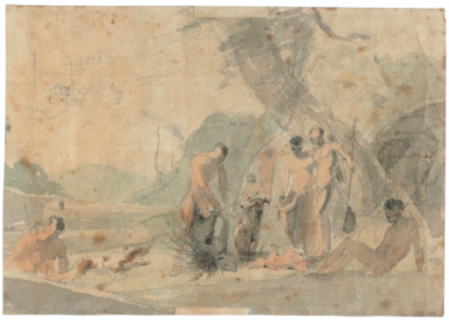
The Landing of Van Riebeck by G.S. Smithard and J.S.Skelton
The British Arrive
In 1794 the French invaded Holland and the following year captured much of the Dutch fleet prompting Britain to to occupy the Cape to prevent the French from doing so. 143 years after Van Riebeck had sailed into Table Bay, Admiral Elphinstone and General Craig entered False Bay and landed troops where Muizenberg is today sited. The Dutch commander soon surrendered and the rule of the Dutch East India Company at the Cape was over.
The first British occupation lasted eight years and little changed, although at the northern and eastern frontier there were problems for the British to deal with. On the northern frontier, ex-slaves and Hottentots were making life difficult for local Boers farmers whilst on the eastern frontier, rebellion had broken amongst discontented frontiersmen.
This was put down by British dragoons and infantry but was soon followed by an invasion of land thought by the Europeans to be ‘their’ land by the Xhosa. This led to the third ‘Kaffir’ war which was ended with the appointed Commissioner of the area, Maynier, coming to terms with the Xhosa, but on terms which antagonised the frontier communities who expected strong force to be used against the Xhosa.
The British Return
By 1802 the frontier had calmed down whilst in Europe, the British signed the Treaty of Amiens and returned the Cape to Dutch officials who included Commander de Mist who was in sympathy with many of the revolutionary ideas coming out of Napoleonic France. When he began to introduce liberal ideas to the Cape, the ultra -conservative people at the Cape were not impressed. The idea of secular education and the introduction of written contracts when hiring Hottentot servants were sacrilegious. The Calvinists at the Cape did not believe in tolerance and could not support the right to worship in whatever way one wished. The Cape had been untouched by political and intellectual developments in Europe and horrified at what was happening to their society. The British returned in 1806 by which time war with France had restarted, and Britain wanted to ensure that Holland, Napoleon’s ally, did not interfere with British trade. In January 1806 a British fleet of 61 ships appeared off the Cape with 6,700 soldiers, and the Dutch commander had little choice but to surrender. This second British occupation was permanent although it was not made official until 1814 when Britain paid £6 million for the territory.
Britain’s latest colonial possession consisted of a Dutch speaking minority of about 20,000 with a black population made up of 25,000 slaves, 15,000 Khoikhoi and a few thousand Bantu on the eastern frontier - then held to be the Great Fish River. In 1814 Lord Chalres Somerset was appointed Governor of the Cape Colony and it was not long before he was acquainted with the fragile situation on the eastern frontier and writing letters to the Colonial Secretary in London, Lord Bathurst, to send out more migrants to be sent out and settled on the frontier. He supported the idea of a government sponsored migration scheme, as did many others. With a fifth Kaffir War breaking out in 1818, the British government decided to take action and appointed a Committee to investigate the likely success of a migration scheme. There were those like William Burchell, a well known botanist in South Africa and some-one familiar with the eastern frontier, who questioned the wisdom of sending settlers to the region as he considered the land ill-suited for farming - he preferred land closer to the Fish River - but the British Government decided to go ahead with he scheme and on the 12 July 1819 £50,000 was voted for by the British Parliament for the Cape Emigration Scheme.
The scheme as it stood probably had a number of objectives. Firstly, to settle the volatile eastern frontier with a farming community whose presence would go some way towards deterring attacks on farms in the region and which would act as a buffer between the Boers and the Xhosa. Secondly, the existence of 5,000 English speaking migrants would help to strengthen the English-speaking culture and administration, and thirdly the post-war period in England saw huge poverty as the British economy suffered a post-war recession.
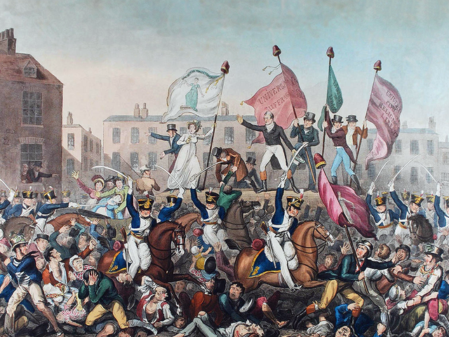
The Peterloo Massacre by Richard Carlile
The Impact of the Peterloo Massacre
Demobilisation of soldiers from the Napoleonic Wars together with the speedy industrialisation of agriculture and industry resulted in a large increase in unemployment. The Peterloo Massacre of 16 August 1819 in which 18 people and up to 700 injured was a stark reminder of the distress caused by rapid industrialisation, and although it took place after the Emigration Scheme was announced, it would have acted to promote the idea of emigration as a way of escaping the social and economic horrors of life in industrial England.
90,000 Applications for the Emigration Scheme
There were as many as 90,000 applications to become part of the Emigration scheme. Selection was limited to men who could afford to engage at least 10 able bodied labourers over the age of 18 and lead them to their designated grants of land which amounted to 100 acres of land in the Eastern Cape together with a further 100 acres for every man in the leader’s party. The terms by which the men were engaged were up to the leader. Many men in a party were engaged as indentured servants and had to commit to a number of years’ service to the leader after which they would acquire their own land and be freemen.
Unfortunately, many of the men engaged and often the leader himself had little experience in farming and found the conditions in which they had to prepare land, plant and then nurture crops too difficult, especially as the first three years were years of drought and crop disease. Many men got permission to leave the land allocated to them and went to Grahamstown or Algoa Bay (Port Elizabeth) to look for more familiar work. The migrants may have failed to establish the farms they intended to build, but they helped to establish a British presence by which South Africa was transformed. The local tribes either saw their identity totally destroyed (the Hottentot and the San Bushmen) or their culture undermined by successive wars (the Xhosa) and they found themselves becoming labourers in a British capitalist economy. There was little British influence on the way of life of the area’s character in 1800 but a hundred years later, the British presence had changed the sub-continent for ever.

Most of the settlers established farms between Grahamstown and the coast
By Peter Crowhurst, October 2023
Further reading:
The Story of the 1820 Settlers by Tessa King as presented to the West Rand GSSA on 27 December 2010
The Nineteenth Century, in the Oxford History of the British Empire series, by Andrew Porter, Oxford, 1999
Related Articles