




What was the Scramble for Africa?
In the last quarter of the 19th century, Britain found that it had to act to defend its economic and strategic position in the world. For much of the 19th century Britain ruled supreme over the world with an economic, military, and diplomatic dominance over her rivals. That dominance was to change in the 1870s, as following its Civil War, the USA began to swiftly develop her economy, and with the emergence of independent states in Germany and Italy, together with the industrialisation of France, strong economic rivals to Britain emerged.
These European countries saw the establishment of empires as a way of improving their economies and giving themselves increased status, and with Germany and France in particular seeking to increase or establish empires, Britain had to establish firmer control over territories that hitherto it had had loose relations with. Nowhere was this change in policy more apparent than in Africa where tension with France and Germany led to Britain establishing more formal control over territories that hitherto had been independent African kingdoms.
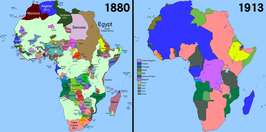
In 1870 there were about 10,000 tribal kingdoms in Africa but by the end of the century hardly an African kingdom remained as Africa was divided between the European powers. Most of this division was achieved with little loss of European lives but at the cost of the destruction of African culture, lives, and most tribal kingdoms.

<
>
The division of Africa in 1880 and 1913
The beginning of New Imperialism
This partitioning of Africa came at a time when Imperialism in Britain was attracting more and more public attention and when politicians were for the first time openly advocating the expansion of the British Empire. On 8 February 1870 John Ruskin delivered a speech in Oxford in which he introduced the theme of Imperial Duty as Britain's destiny and how Britain had a mission to found colonies and settle them with young men who would advance the power of the home country. 'There is a destiny now possible for us, the highest ever set before a nation...This is what England must do or perish’. What Ruskin was doing was to introduce a new ideology for Empire and adding a new justification for the annexation of new territories. This was followed by Disraeli in a speech at Crystal Palace in 1872 putting Empire at the very centre of British politics. Disraeli claimed that the British had a choice before them. They could be subjects of a comfortable England, insular and ordinary or of a great country, an imperial country which commands the respect of the world.
It was the exploits of British explorers like Samuel Baker and David Livingstone that captivated the imagination of the British public who read about their exploits in the books they published. The British government though had no interest in acquiring territory, except in southern Africa where wars between the settlers and the Xhosa in the Cape Colony led to the deployment of British troops. Annexations in the Western Cape followed and then Natal and the land around Durban, was annexed to create the colony of Natal, which was intended to prevent the acquisition of coastal territory by the Boers.
Early European government interest in Africa came from Belgium in 1876 when King Leopold began his imperial project in the Congo. This was followed by France making moves in Senegal in 1879 and occupying Tunisia in 1881. In 1882 Britain occupied Egypt and in December 1884 Germany annexed Angra Pequena (German South West Africa), the Cameroons and Togoland. The Berlin Conference of December 1884 agreed on the apportionment of the Congo, and the following year, 1885, Britain annexed Bechuanaland and the Oil Rivers in Nigeria and set up the private Royal Niger Company.
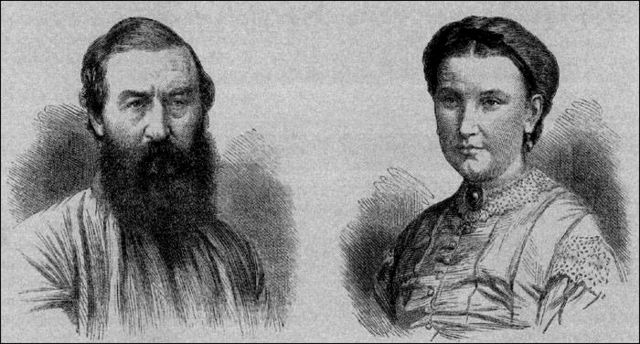
Samuel and Florence Baker
In 1890, to secure her position in east Africa, Britain signed a treaty with Germany by which Zanzibar was acquired in exchange for Heligoland. The British government then granted a charter to establish the Imperial East Africa Company (IEAC) to administer a coastal area of east Africa that stretched from Somalia to and including present day Kenya and then a year later granted another private charter, this time to Cecil Rhodes, to establish the British South Africa Company.
In 1893 the British government took over the administration of east Africa from the IEAC and established protectorates in Uganda (1884) and Kenya (1885). In west Africa, following a war, Britain established a protectorate over the land of the Asante in 1896 and in 1898 reconquered the Sudan.
British actions in Africa in the last 30 years of the 19th century happened in response to the actions of other European countries which were perceived by successful British government as threatening the interests of Britain. British governments always preferred informal empire by which trade treaties were signed with local leaders to allow trade between their territories and British merchants and financiers. Whenever trade was made difficult by local leaders, the British would threaten or use force to allow trade with Britain to continue. Whenever it was necessary for annexations to occur the British governments preferred to do this on the cheap by granting charters to private companies who then negotiated with local elites and paid the costs for the administration and defence of their territories. Only when the private company failed to do this did the British government get involved. So it was then that John Seeley, Professor History at Cambridge, could say in his book of 1883 'The Expansion of England' (1883), "we seem, as it were, to have conquered half the world in a fit of absence of mind."
Southern Africa
Britain had first established a presence in southern Africa , in 1806, during the Napoleonic Wars when British wanted to secure the shipping route to India and the Far East and Pacific by acquiring the strategic base of Cape Town from the Netherlands. Following the Great Trek of Boers out of the Cape Colony in the 1830s to establish settlements to the east, Britain annexed Natal in 1843 to prevent the Boers from controlling an important piece of coastland. Boer republics were subsequently recognised in the Orange Free State and the Transvaal in the 1850s, but tension continued with the Boers until Britain annexed the Transvaal in 1877. The Transvaal Boers re-established their independence in 1881 but tension between Britain and the Transvaal escalated following the discovery of gold on the Witwatersrand in 1886. Rumours of gold existing in the lands north of the Transvaal were spread by explorers and further encouraged by novels like 'King Soloman’s Mines' by Rider Haggard. By this time explorers for gold and concession hunters were seeking to establish rights to mine on the tribal lands of the Ndebele from the king, Lobengula.
The German Chancellor, Bismarck, sought to make political capital out of the situation in south Africa and challenged the British by establishing a German protectorate in Angra Pequena in 1884. Bismarck was not interested in establishing German colonies except as using them in his geo-political game of isolating Britain. The declared non-imperialist British Prime Minister, Gladstone, was persuaded to send a British army to secure control over the lands between German South West Africa and the Transvaal and establish a British protectorate in Bechuanaland.
To secure Britain’s position in south Africa the British Government gave Rhodes a charter which enabled him to create his own military force and invade Matabeleland, the land of the Ndebele. Such a charter had been made possible by Rhodes’ business partner, Charles Rudd, negotiating a concession to mine for gold and other minerals, in return for which Lobengula was promised 1,000 Martini-Henry rifles. Rhodes subsequently invaded the land of the Ndebele and Shona and in two wars in the 1890s went on to annex over a million square miles of territory and establish what became the colonies of North and South Rhodesia and Zambia.
When in 1896, a Cecil Rhodes inspired plot to invade the Transvaal and bring down the Transvaal government led by Paul Kruger failed, the Kaiser, William II, sent a letter to Kruger congratulating him for foiling the attempted coup d’etat. The fear of a German supported state in south Africa was enough for Britain to try and force Kruger into a treaty in which he would have to accept a number of British demands. Instead, Kruger opted for the war which broke out in October 1899.
North Africa
In north Africa, both the British and the French had economic and financial interests. The decline of the Ottoman Empire had led to the French conquest of Algeria in 1830 and then the occupation of Tunisia in 1881. With the compete collapse of Ottoman control, this opened the way for several European powers to become involved in north Africa. Egypt was the most prosperous of the Ottoman provinces and became an area of conflict between Britain and France. Egypt gained its independence from Ottoman control under the leadership of Khedive Ismail Mehmet Ali in 1847 and his government then sought to modernise the country by bringing in European specialists and borrowing from European banks. It also negotiated with the French to set up a company to build the Suez Canal. The canal opened in 1869, but initially made little money and bankrupted Khedive Ismail. The British and French set up a debt commission to manage the Egyptian debt and this sparked a nationalist rebellion led by the army officer Colonel Urabi.
The French government did not wish to take part in any war against Urabi and left it to the British to send an army to Egypt under Wolseley which defeated Urabi’s army at Tel-el-Kebir. A British army stayed in Egypt and Britain controlled the new administration of the re-installed leader, Tewfik Pasha. British trade through the Suez Canal was enough to persuade the British that their presence was required in the region. It also meant that Britain had to deal with the nationalists in the Egyptian territory of Sudan which eventually led to General Gordon being sent to Khartoum to organise the withdrawal of British forces from Sudan. The British gained their revenge in 1898 when an army under the leadership of General Kitchener defeated a larger force at the Battle of Omdurman. Soon after the battle, Kitchener found a small French force at Fashoda seeking to establish a French claim over the region. Both Kitchener and Marchand referred the issue back to their respective governments and finally, in the face of a vastly superior force, Paris had to give way and signed an agreement in March 1899 acknowledging British control of the Sudan.
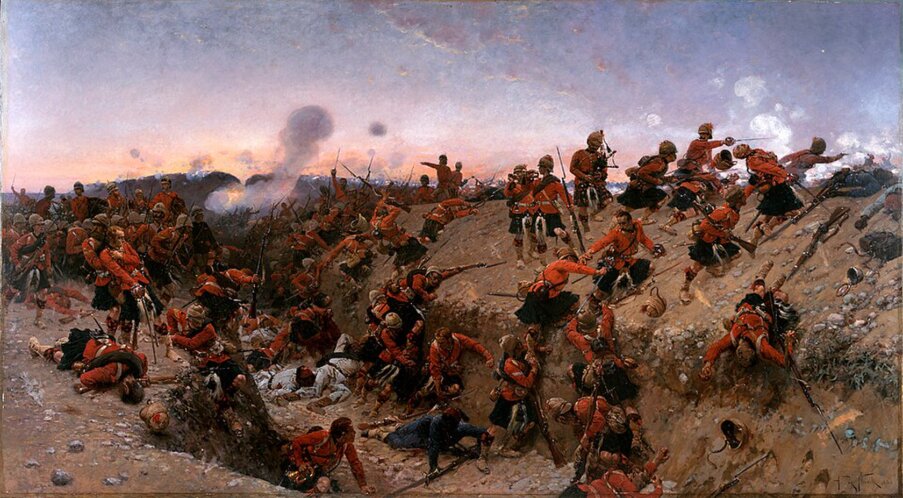
The Battle of Tel-el-Kebir
West Africa
In west Africa the French had a stronger interest than the British. The coastal region of west Africa had always been important for Britain, but the government was reluctant to have any formal relationship with local leaders. The area was important initially for the slave trade and later for trade in palm oil, but the conditions for Europeans were dreadful with the area regarded as a graveyard for anyone staying too long. British merchants were able to establish good trading relations with local tribes, especially the Fanti of the Gold Coast but once the more powerful Asanti threatened their trade, the British government decided to intervene. The Asanti, who had become one of the most powerful states in west Africa, largely based on the slave trade, resented British efforts to suppress the slave trade, and determined to extend their area of influence throughout the coastal region of the Gold Coast. The British signed a number of treaties with the Fanti, promising protection, but when the British refused to return a fugitive slave, the Asanti invaded the ‘protectorate.’ In 1874, the British government sent a military expedition under general Wolseley to punish the Asanti. Wolseley led an army through the thick bush to the Asanti capital of Kumasi and proceeded to loot the town and then burn it down. The British military victory attracted a lot of publicity as the expedition was accompanied by correspondents, including Stanley and Haggard. The British government decided in the face of this native threat to annex the Gold Coast, as by the 1870s the French were extending the areas under their control or influence. The French had already extended the colony of Senegal and in the 1870s and 1880s established a protectorate over Porto Novo to prevent Britain from having an unbroken stretch of coastline.
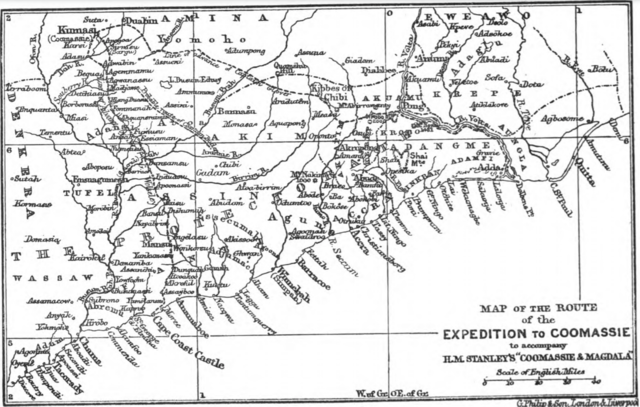
Stanley's map for the route to Kumasi
The Berlin Conference
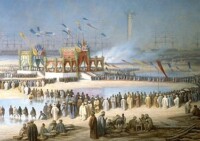
The Congo River and hinterland attracted several European countries including Belgium, Portugal, and France. Britain, an old ally of Portugal, signed an agreement with the Portuguese in 1884 to recognise its claims over the mouth of the Congo but the whole question of who got what from the region was put before an international conference in Berlin, initiated by Bismarck. The conference took place from November 1884 to February 1885 and discussion focused mainly on the Congo and Niger regions. Britain had already got agreements with local tribes in the Niger region and the conference accepted Britain as the dominant power in the region in exchange for freedom of navigation along the river system of the Niger. There was a similar agreement reached for the Congo region with Leopold’s Congo state recognised as the sovereign state but with freedom of navigation along the Congo River and freedom of commerce for all. Any rights claimed by the tribes living in all these regions were ignored.
The Conference of Berlin helped to apportion the territory of the Congo and Niger basins amongst the European powers and minimised the possibility of war between them, but little account was taken of the rights of the native peoples living in these and other regions. In 1881, the British army had almost 26,000 troops based worldwide in the colonies to support settler governments against the threat of violence. They were scattered around the world so that troops could be moved quickly to wherever they were needed. In the last twenty years of the 19th century, there were conflicts in the Transvaal, Egypt, Sudan, Bechuanaland, Burma, Sikkim, Manipur, Asanti, Matabeleland, Waziristan, Chitral, Mashonaland, China, and South Africa.
Africa had become important for the British to secure trade routes to India and the Far East, and to prevent the imperial projects of Germany and France but ‘mission creep’ had resulted in vast areas being annexed. The continent had become an important part of the global economy with ivory, rubber and diamonds becoming essential commodities, and with settlements established in east and south Africa the Government was committed to ensuring the British position in Africa was not weakened.
By Peter Crowhurst
May 2023
Further Reading:
Kathleen Burke, Great Britain and the Scramble for Africa, Gresham College, 2006
Professor Richard J Evans, The Scramble for Africa, Gresham College, 2011
Ronald Hyam, Britain’s Imperial Century, 1815-1914, Palgrave, 2002