


Thomson Hankey
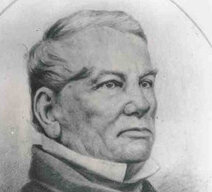
Thomson Hankey was a London based West India merchant and an owner of plantations in the West Indies who was an example of the class of merchants that The UCL Legacies of British Slave-ownership project revealed as huge beneficiaries of slavery and the slave trade. Hankey himself was the beneficiary of seven claims made for compensation for the release of enslaved people.
Hankey was born on 13 February 1773 at his father’s house at 7 Mincing Lane , East London to John Hankey and Elizabeth Thompson. Mincing Lane in the c18th was the world’s leading centre for the trade in tea and spices after the East India Company took over from the Dutch East India Company in 1799. It was also the centre for the British opium business as well as other drugs. Businesses involved in the Atlantic trade, including the slave trade were also based in the street.
John Hankey had been apprenticed to Peter Simond, a merchant of Austin Friars and in 1764, at the age of 23, went into partnership with Peter Simond in the firm of Simond & Hankey of 7 Mincing Lane, a business which included three ships involved in the Atlantic trade, and properties and mortgages in Grenada, Jamaica and Antigua. It was in the family home and the family business centre at 7 Mincing Lane, that John and Elizabeth brought up their two boys, John Peter and Thomson. It was always intended that the eldest son would join the family firm and that Thomson would join the East India Company.
His mother runs away with an army officer
In 1781, Hankey’s wife, Elizabeth took a house in Brighton for her health. John, her husband did not accompany her as he was suffering from gout and had business in London to deal with. It is not known whether John Peter or Thomson accompanied his mother, however whilst in Brighton, Elizabeth met Turner Straubenzee, Lieutenant Colonel of the 52nd Regiment and ran away with him, first to Dorking and then to Scotland. When the regiment was sent to India to fight in the war against Tipu Sultan, Elizabeth went with Straubenzee and bore him a son. John Hankey meanwhile sued for divorce, which was granted in 1783 on the condition that neither party re-married. Despite this condition Elizabeth and Turner got married in Madras. Elizabeth died on 23 October 1785, most likely not ever having seen her children again. She did write to her two sons of her life and her travels in India but was not able to see them again.
Thomson joins the Madras civil service
John Hankey had planned a career in India for Thomson, his second son, and in preparation for this Thomson completed in 1792 a course in Merchant Accounts at Eaton & Boutflower’s Academy in Tower St. He then left for India becoming a writer in the Madras Civil Service on 1 August 1792, just weeks before his father died. At his death John Peter became a partner in the family firm. The following year Thomson Hankey was Assistant under the Resident (the leading British representative) at Salem. In 1794 Hankey returned to England but went back to India arriving on 2 September 1794, becoming Deputy Commercial Resident at Salem. He resigned his position in India on 28 March 1800 and returned to England.
The following year, whilst living in Broad St, London, Hankey married Martha Harrison on 2 June, at St Benet, Paul’s Wharf, and they set up house in Dalston, where all the children, five sons and eight daughters, were born. The family later moved to 45 Portland Place which remained the main family home for the rest of their lives although they did spend a good deal of their time in Brighton. In 1807 John Peter died and Thomson became senior partner in the family firm, Simond & Hankey. The firm’s name was changed in 1826 to Thomson Hankey & Co and the firm retained the name, until in 1947 it became a limited company.
A financial interest in West Indian plantations
Although based in London, the firm had an interest in a large sugar plantation in Grenada, known as Grand Bras Estates. As well as administering the plantation, the firm as London merchants would have engaged in arranging for the sale and transportation of goods to and from the West Indies. Such a multiplicity of tasks and ownership was common for London merchants who had interests in the West Indies trade. When slavery was abolished in 1833 Thomson Hankey claimed successfully for the loss of eleven estates and received over £49,706.
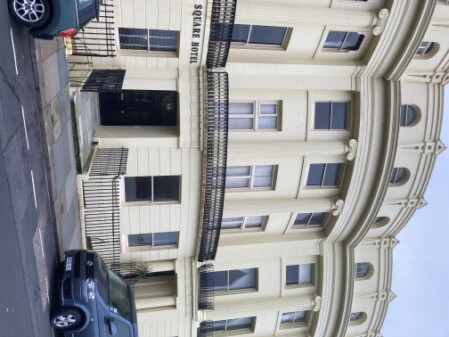
10 Brunswick Square
Brighton
At the time of his claim for compensation, Thomson was living at 10 Brunswick Square, Brighton. The family were frequent visitors to Brighton, most likely for the ‘season’. They came with their family, which included their daughters Isabella and Albinia, who both enjoyed the grand balls they were invited to attend at The Royal Pavilion. On one occasion on 3 February 1831 five of the women on the guest list were residents of Brunswick Square.
The family stayed in a number of places in Brighton as well as 10 Brunswick Square: No 4 Brunswick Square and the Old Ship, the Albion, and the Norfolk Hotels. The family main home remained 45 Portland Place, London but frequent visits were made to Brighton and it was at 10 Brunswick Square that Thomson died on 26 October 1855. The death was registered in Steyning and Thomson was buried in the family vault in Kensal Green.
By the time of the Abolition of Slavery, Thomson’s
eldest son, Thomson jun, was a partner in the family firm and himself the
beneficiary of money awarded as compensation. Thomson jun had joined the family
firm and became the longest serving senior partner in Thomson Hankey & Co. He
was elected a director of the Bank of England in 1835, served as Deputy
Governor of the Bank 1849-1851, before becoming Governor in 1851. After two
years as Governor he became Liberal MP for Peterborough between 1853-1868 and
1874-1880. He died in 1893.