





What was the Role of the Royal Navy in the 19th century?
The British Empire floats on the British Navy
The Victorian era saw Britain become the workshop of the world and dominate the world in the fields of industry, commerce, finance, and shipping. At the time of the Great Exhibition in 1851 Britain produced two thirds of the world’s coal, half of its iron, five sevenths of its steel and half of its commercial cloth. Britain was unchallenged in any of these areas and was able to build an empire that by the end of the century was the largest the world had ever seen. In 1905 Admiral Lord Fisher, in a report inaugurating the Committee for Imperial Defence declared that The British Empire is pre-eminently a great naval, Indian and colonial power.’ He went on to say that ‘The British Empire floats on the British navy.’ Certainly, it is true to say that without command of the seas there would not have been a global British Empire, but there were two other important factors that were the basis for Britain’s imperial and economic dominance in the 19th century. They were trade and the very existence of an empire with its territories spread all over the world. The trinity of the Royal Navy, trade and empire together formed the foundation of Britain’s extraordinary success in the years between 1815 and 1914.
The British Empire was a trading empire, and the prime motive for empire was trade. Britain was the first country in the world to undergo an industrial revolution in the late 18th century, enabling Britain to manufacture goods cheaply and in great quantity. Industry in the early part of the 18th century was usually quite small and based in workshops. The textile industry, for example, involved thousands of spinners, weavers and dyers working mostly at home. Small scale production was a feature of all industries as sources of power were limited, and based on water, horse, or wind power. It was with the development of steam technology in the late 18th century that the situation changed.
The industrial revolution
In 1769 Richard Arkwright patented his ‘water frame’, which allowed large-scale spinning to take place on just a single machine. This was followed by James Hargreaves’ ‘spinning jenny’, which further revolutionised the process of cotton spinning. The weaving process was also improved by advances in technology, especially by Cartwright’s power loom, developed in the 1780s. With the advances in steam technology, efficient machines could be installed in factories so that by the 1770s there were cotton factories producing cotton manufactured goods in Nottingham and Cromford. By 1800 there were over 2,000 steam engines at work in Britain. Such changes were made possible because there were inventors, entrepreneurs to invest money in factories, a surplus of labour ready to work in such places and an expanding population to provide a market. There also existed the raw materials: wool, coal, and iron. Such factors as these were only present in Britain giving Britain an industrial revolution decades before any other country. The factories produced textiles, and goods manufactured out of iron, and were able to produce these in such quantity that the British market was insufficient. New markets were needed and also new sources of raw materials.
Trade was always the main motive for empire
The early colonies of empire established from the early 17th century in the West Indies and the American mainland were established to provide a ready supply of raw materials and in return receive the manufactured goods made in Britain. With the growth of the industrial revolution, it became more important to locate new sources of raw materials and new markets, and the 19th century witnessed a huge increase in the number of places with which British merchants traded.
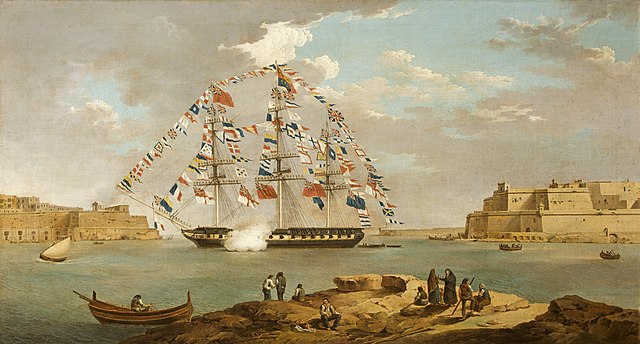
Royal Navy ships of the line in Malta harbour
An informal empire was always the preferred option for government
The preference for the British government and British merchants was to establish a trading relationship with countries or territories that did not involve a formal annexation. British traders in the 19th century wanted certain rights: to be able to exchange goods freely and fairly, have agreements honoured or with the right to legal redress, have trade open to all nations without any discrimination, be secure against any threat to their person or property, and have reasonable access for their ships to docking and supply facilities. Often these requirements were met with a treaty being signed by both parties, as when Argentina signed such a trade agreement with Britain in 1825. Such arrangements suited British merchants as Britain had a monopoly in the supplying of manufactured goods. There might also be a British consul in place in important trading ports like Buenos Aires. This was the preferred way by which traders operated but if these arrangements broke down, that left the possibility of more formal arrangements with Britain annexing a territory or imposing trading arrangements with naval or military force. It might be the case that the political structure in a territory was too weak to enable stable commerce to flourish, or that there had been a civil war. In this case the Royal Navy often played an important part in ensuring that trading arrangements were adhered to. In West Africa, and China, Britain fought wars to maintain the trading status quo, and annexed territory to ensure that the trading status was maintained. The government was reluctant to formally annex territory as this was expensive and required setting up a permanent administration together with the military force required to defend that administration.
The changing role of the Royal Navy
In the 19th century the Royal Navy changed its role so that it became part of the trading system. Merchants felt that should their own personal position or the trading status quo be threatened, they could always call upon the support of the Royal Navy and the navy effectively became an arm of Britain’s trading system. This necessitated a complete change in the role of the Royal Navy, but it was able to rise to the challenge of adapting to new roles with fewer ships and a smaller budget because the Royal Navy was unchallenged until the late 1880s.
Until 1815, Britain concentrated the fleet in home waters, with the western squadron based off south west England to interrupt any hostile expedition by European rivals. The superiority of the Royal Navy enabled Britain to win the 18th century Anglo-French struggle for empire. Victories in Canada and India had been made possible by the Royal Navy controlling the seas and preventing the resupply of materials and men by the French and Spanish to the Americas and India. Victory over Napoleon was largely attributed to sea power as Britain confined French power to Europe. The navy guarded the convoys that resupplied Wellington in the Peninsula War and guaranteed the survival of Britain’s global commerce which generated the wealth which paid for the war effort and contributed to the cost of the European armies that fought alongside Wellington.
Why was the Royal Navy superior?
This superiority was established in the 18th century and was due to a number of factors. The officers and crews of Royal Naval ships had a self-confidence and professionalism that was far superior to that of the Dutch, French, and Spanish. Their gunnery and seamanship was superior and was demonstrated in the victories at Cape St Vincent, Camperdown, Abukir Bay and Trafalgar. The Royal Navy had leaders like Nelson, Duncan, Jervis, and Collingwood who were superb tacticians and leaders of men. They also were able to take important decisions on the spot as indeed were officers of a lesser rank. With naval establishments located around the world in places like Malta and Alexandria, ships were able to stay at sea for far longer. Captains also were able to take advantage of a network of intelligence provided by Lloyds shipping insurance agents from 1793.

The Battle of Trafalgar, 1805
Britain was the only global naval power
he Napoleonic Wars left France and Spain economically and militarily weakened so that they spent the next few decades not only recovering from the effect of war but having to deal with internal instability. Their empires had been weakened as Britain had occupied so many Spanish and French territories, which added to Britain’s empire making it a truly global power. Britain’s grip in the Mediterranean was strengthened by the acquisition of Malta and the Ionian Islands, and in the North Sea by the addition of Heligoland. In the Atlantic Sierra Leone, Gambia and Ascension were added whilst in the south Atlantic Cape Town was added in 1806 giving Britain control of the routes towards India. In the Indian Ocean, Britain acquired Mauritius, the Seychelles and Ceylon and further east, Malacca. In the West Indies St Lucia and Tobago as well as Guiana were added. Many of these colonial acquisitions provided important naval bases which became important for resupplying ships and later for re-coaling ships. Later in the century, Aden (1839), Hong Kong (1842), Labua (1846), Lagos (1861) and Mombasa (1890) were added to this chain of naval bases.
These bases scattered around the globe enabled the Royal Navy to play a completely different role, indeed a number of roles, to that played in the 18th century. It was henceforth to be a navy that was a protector of commerce, a defender of British interests throughout the world, especially where there was a lack of stable government, and an instrument of foreign policy. It was able to do this because the Royal Navy was unchallenged anywhere in the world and because its objectives largely were accepted by rival European powers. In suppressing piracy and ensuring that trade should be freely conducted without any discrimination (after the abandonment of tariffs by the British in the 1840s), European powers benefitted from the British policy and were happy with the naval deficit. It meant they could concentrate on bringing economic and political stability to their own countries.
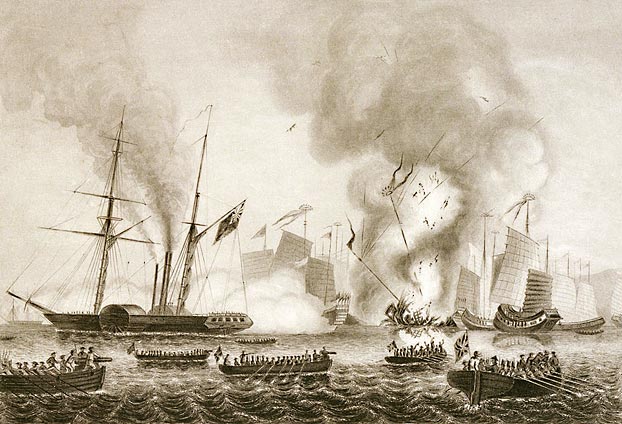
A British naval ship during the Opium War
Suppressing piracy
A major role for the navy was in suppressing international
piracy which hindered maritime trade in places like the north African coast
(Algiers), China and the shores of the eastern Mediterranean, where conditions
for fair and free trade did not always exist. Britain was always prepared to
use naval force to suppress piracy if at all possible and developed ships
capable of sailing up rivers to deal with piracy. In 1821 when a British
merchant ship was seized off the coast of Puerto Rico, and no compensation was
offered by Madrid, Lord Collingwood confronted the Spanish Governor of the
territory to recover the captured vessel. Palmerston sent seven battleships and
five steamers to Salamis Bay after the Greek government refused to pay
compensation for the losses incurred by a number of British citizens. The Greek
navy was seized, and Greek merchant ships held. In 1839 Britain went to war
with China over the attempt to disrupt the trade in opium and the first of
three wars was fought with the Chinese before the Chinese agreed to trade with
the west. The situation in China illustrates what Britain was prepared to do if
informal trading arrangements broke down. However, the power to bring about a
change in administration was often limited. A Latin American squadron was
established between 1843-46 to prop up a weak Uruguayan regime threatened by
Argentinian supported forces. Little was achieved, and indeed gunboat diplomacy
had limited success. Beyond navigable rivers British power was limited, unless
a large military force was used, and this was politically, economically, and
militarily difficult. One exception to this was the joint Anglo-French military
force used in 1860 to enforce agreements made with the Emperor of China. The
resultant force led to the sacking of the Summer Palace in Beijing.
The West Africa slave trade squadron
In 1808, following the Abolition of the
Slave Trade by the British Parliament a year earlier, the Royal Navy
established a squadron of ships based on the West African coast, the West
Africa Squadron, whose job it was to
suppress the trade in slaves to the USA
and the West Indies. Between 1808 and 1860 the Royal Navy’s West Africa Squadron
seized nearly 1,600 ships involved in the slave trade and freed 150,000
Africans bound for the plantations of the Americas. The patrol began with just
a few vessels, including privately owned ships, but after 1815 the number of
ships in the patrol increased dramatically, and by the 1850s there were 25
ships with 2,000 officers stationed in West Africa. Britain used naval force
and diplomacy to reduce the level of trading in slaves however a quarter of all
the slaves who were transported across the Atlantic were transported between
1807 and 1870 so the success of this squadron was limited.
In 1815 the Royal Navy had about 214 ships of the line (able
to take part in a line of battle) and 792 cruisers of different types. Many of
these ships were old and unfit for
service and were subsequently scrapped. By 1828 there were just 68 ships of the
line, and this figure was further reduced to 58 by 1835. France had about 50
ships of the line, but most were unfit for service. It was only in the
mid-century that France posed a possible threat to the Royal Navy, but the advent
of iron and steam ships enabled Britain to pull well clear of France and the
United States.
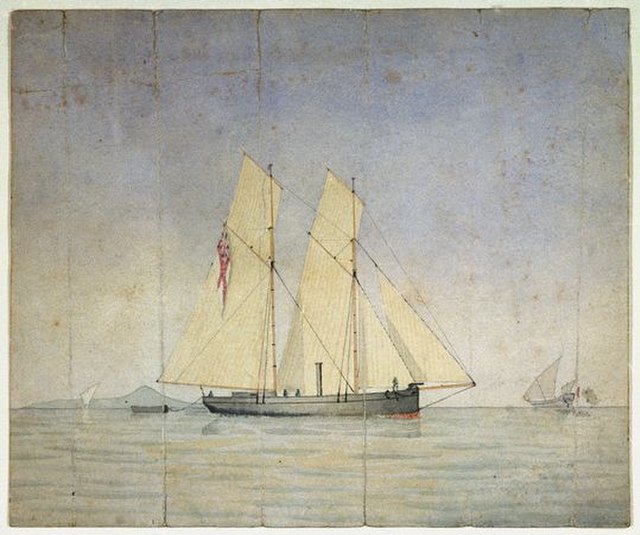
The Royal Navy chasing a slave trader
Developments in the building of naval ships
The French navy was the first to build an iron clad, steam propelled warship, the Gloire, in November 1859, during a time of increased tension between Britain and France. Britain started building two iron ships in 1859, and once the decision was taken in 1861 to move towards an all-iron fleet, British superior industrial capacity meant that Britain was able to strengthen her naval advantage. This change came slowly though. A wooden ship was launched as late as 1859 when HMS Victoria was launched, the last wooden ship to see service. Only in the 1880s did steam overtake sail in terms of tonnage. This change from a wooden ship with sails, and supplementary steam power to all iron ships with extra armoured protection for decks and sides and with new powerful iron guns meant a transformation in naval warfare.
HMS Warrior, now in Portsmouth, was together with her sister ship, HMS Black Prince, the first steam powered armoured frigate built for the navy and was built in response to the French ship, the Gloire. Capital ships of the line continued to be propelled by a combination of steam and sail until 1873 when HMS Devastation was launched, the first capital ship not to have to have sails and the first which mounted the entire main armament on top of the hull rather than inside it. It had four 12’’guns and a speed of 13.75 knots.
The Royal Navy fought just one action against another ship in the 19th century, against the Peruvian ship, Huascar in 1877. Royal Navy ships though did have men trained to conduct operations on shore. These naval brigades fought in a number of wars: the Crimean War, Second Opium War, the Abyssinian expedition, the Second Ashanti War , the Zulu war, the Egyptian campaign of 1882, the Boer War, and the Boxer Rebellion in China. Details of the Naval Brigades action in the Second Boer War can be found here.

HMS Warrior
From the late 1860s, British naval superiority began to be threatened. From
1878 Russia, Italy and France adopted ambitious naval building programmes.
Britain’s naval weaknesses were exposed in 1884 by the editor of the Pall Mall
Gazette, W.T. Stead, prompting a review of Britain’s naval strength. The
result, the 1889 Naval Defence Act, confirmed that Britain’s naval strength
should adhere to the two power standard whereby Britain’s naval strength was
equal to the strength of the next two largest navies. A naval race now began.
By 1898 Britain possessed 52 battleships with a further 12 under construction.
France and Russia together had 39 battleships with another 18 being built. This
though did not consider Germany’s navy ( 17 plus 5). It was quite apparent that
Britain could not continue to have a navy equal to the total of all possible
rivals. Britain’s weakening position was emphasised in 1892 when a Russian
naval squadron sailed into the Mediterranean Sea from the Black Sea and then
sailed to Toulon, the main French base in the Mediterranean. This was prior to a
Franco-Russian alliance being signed in 1894.
The ability of Britain to control the Mediterranean was being threatened by
the growth of the French, Italian and Russian fleets, and the importance now
being given to the east Mediterranean as a British sphere of interest. With the
opening of the Suez Canal in 1869, the maritime route through the Mediterranean
to India and the Far East became the quickest route cutting several thousand
miles off the route via Cape Town. Russian ambitions to control the Balkan peninsula
became quite clear during the Russian-Turkish War of 1877-78, and although
Russia was humiliated in the subsequent Berlin Conference, Russia would
continue to be a threat to British interests in the area. A weak Ottoman Empire
made that threat much greater.
The instability of the Middle East due to a weakened Ottoman regime, meant
Britain had to intervene to prevent the growth of Russian power in the region.
The cold war between Britain and Russia, the Great Game, caused debate within
British naval and military authorities about Russian intentions towards India,
Britain’s major trading partner. Any Russian control of the eastern
Mediterranean would threaten Britain’s ability to protect India. When in Egypt,
the nationalist leader, Arabi Pasha led a revolt against the Anglo-French
supported leader Khedive Tewfik in 1879, Britain and France sent a force to
Alexandria and when Pasha reinforced Alexandra’s defences the Royal Navy bombed
the city. A few months later a British
army under the command of General Wolseley landed north of Cairo and attacked
Pasha’s army at Tel-el-Kebir and defeated it. Britain then brought back Tewfik
and established a British controlled government. Egypt remained a British
protectorate until troops were withdrawn in 1956.
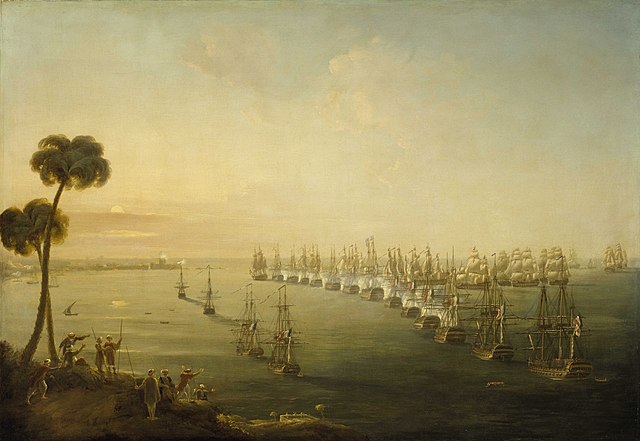
The Battle of the Nile
A naval race begins
The cold war between Britain and Russia continued with Russian troops
appearing on the Afghanistan border in 1885. Russian railway building had
brought Afghanistan within striking distance, and with that a possible threat
to India. Russia would be able to mobilise 300,000 troops on the Afghanistan
border against 95,000 British and Indian troops on the north west frontier of
India. The geopolitics of the region meant that Britain would have to
reconsider her ‘isolationist policy’ of not discussing the areas of tension
that existed between France and Britain (Africa) and Russia and Britain (the
Middle East and India).
Britain’s increasingly difficult position was emphasised when in 1898 the
German Naval Law outlined a programme of naval building which would bring about
a German navy able to operate on a global
scale. The Kaiser had been inspired by reading Alfred Thayer Mahon’s book on ‘The
Influence of Sea Power on History’. Maher was an American whose analysis of
empires concluded that sea power was crucial to the power and wealth of
countries. He cited the example of Britain’s maritime force in the 19th
century, and his analysis encouraged a surge in naval building in the years
prior to 1914.
Britain embarked on a rebuilding programme and a redistribution of the fleet
as the policy of using the fleet to support commerce was partially abandoned in
order to give priority to the defence of the homeland. This was done in
conjunction with a realignment of the major powers, as Europe divided into two
camps. In 1894 France concluded an alliance with Russia prompting Britain to
abandon her policy of not making firm commitments with other countries when in
1902 a defensive treaty was concluded with Japan. This enabled Britain to
withdraw some of her naval strength from the Far East. Britain then set about
resolving her differences with France and in 1904 a Treaty of Friendship was
agreed by which France agreed to
recognise Britain’s position in Egypt in return for Britain recognising French
interest in Algeria. This paved the way for an agreement for Britain to
withdraw ships from the Mediterranean to be used in home defence in return for
French ships to be moved from the Channel to the Mediterranean. Eventually in
1907, Britain signed a Treaty of Friendship with Russia by which Russia
accepted British interests in India, and both sides agreed to divide up their
interests in Persia (Iran).
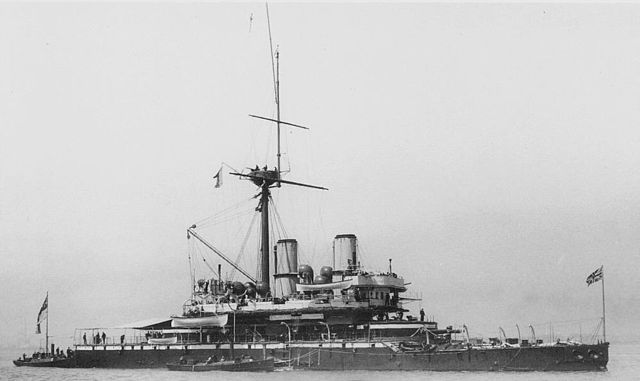
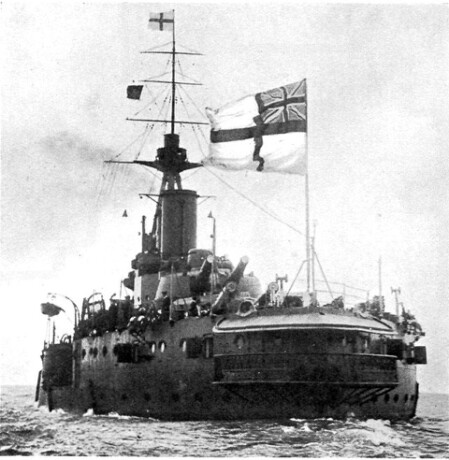
HMS Devastation in 1896 after a refit
Fisher's rebuilding of the British fleet
Meanwhile Admiral Lord Fisher was modernising the British fleet. He pushed
through the design and building of a completely new type of battleship, the
Dreadnought class, with the first of the class, HMS Dreadnought, being completed
in 1906. Displacing 17,900 tons and with its 10 12’’guns and a cruising speed
of 20 knots, it immediately made every other battleship out of date. Three more
of its type were laid down in 1906-7, together with two battlecruisers with
eight 12’’ guns. Every Dreadnought type battleship built between 1906 and 1914
was based in the Home fleet. Many of the gunboats and sloops associated with
colonial expeditions and defending the formal empire, 150 in total, were scrapped
as the role of the navy changed. In 1896 there had been 74 ships based in home
waters compared to 142 based overseas. By 1910 there were 480 ships based in
home waters and just 83 based overseas.
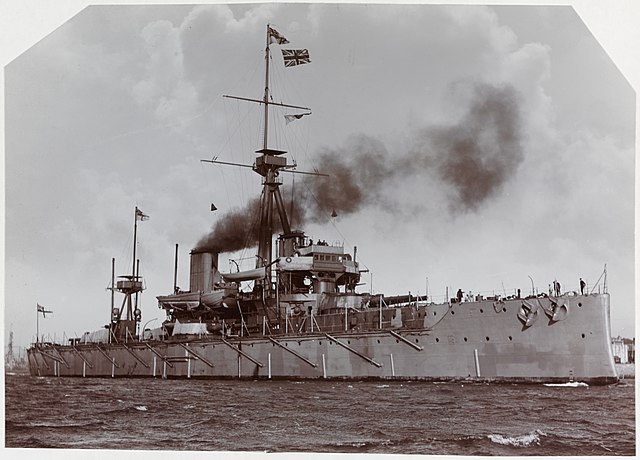
HMS Dreadnought in 1907
As well as the rebuilding programme, ships were withdrawn from bases around the
world. The West Indies, the Cape, Australia, and China were left without any
capital ships whilst there were just two capital ships based in the Mediterranean.
The makeup of the Royal Navy, its distribution and role had completely changed
from what it had been throughout the century. Prior to 1815, the role of the Royal
Navy had been to blockade its European rivals and to destroy in battle its
naval capacity at any opportunity. After 1815 the role of the navy became the protection
of the maritime trade routes and British interests abroad. The increasing
strength of the European powers in the last thirty years of the century, and in
particular the growth of their navies forced the Royal Navy to re-assess its
role, and to concentrate on building large capital ships which would be based
in home waters. This left Britain’s trade routes undefended and prey to ocean raiders
in the Great War.
By Petr Crowhurst, May 2021
Further reading:
Darwin, John, Unfinished Empire, 2012
Hyam, Ronald, Britain's Imperial Century, 2002
Kennedy, Paul, The Rise and Fall of British Naval Mastery, 2017
Porter, Bernard, The Lion's Share, 1975
Related Pages