


Part 5
Brunswick Town
Case Studies
I have looked at 19 of those who appear on the LBS database in more detail to try to discover when and why they were in Brighton or Hove. They lived in either the Brunswick area or along Brighton’s east cliff. I have looked at the development of these areas as well as studied the lives of the group.
Brunswick Square and Brunswick Terrace
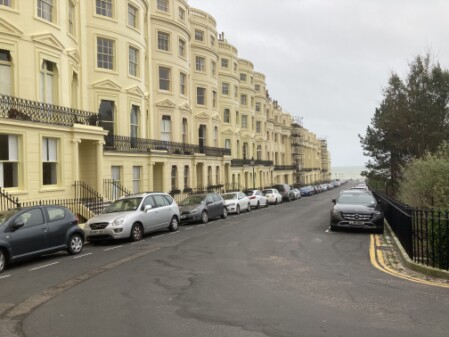
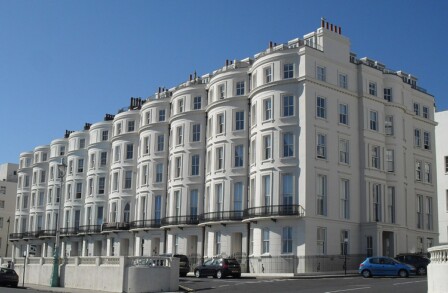
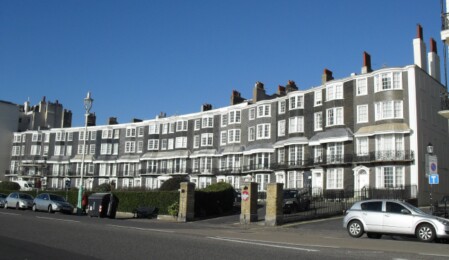
There were more people from my list of 75 living in Brunswick Square and Brunswick Terrace than anywhere else in Brighton or Hove. Built by the Wilds and Busby, described above, the Brunswick Estate with its grand terraces of large first-class buildings, appealed to the wealthy elite classes. The houses in the Square were built for owner-occupiers whilst the houses in the Terrace were intended to be rented out for both short and long stays. There were people from the database at nos 10, 12, 38 and 39 Brunswick Square and at nos 1 and 29 Brunswick Terrace. Amongst them there were slave owners, plantation owners, successful claimants of compensation money, unsuccessful claimants, executors, trustees and those with no connection to slavery or the slave trade.

Comments welcome using the Contact Form
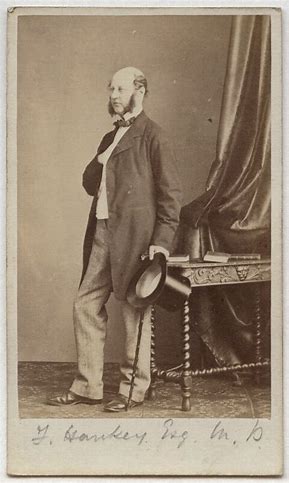
Thomson Hankey (1773-1855)
Thomson Hankey, a London based West India merchant, lived in Brighton or Hove from at least the early 1830s. He was a partner in the company Thomson Hankey & Company of Mincing Lane, London, which owned a number of plantations in Jamaica, Antigua and Grenada. Hankey’s main home was in Portland Square, London but he was a frequent visitor to Brighton. He stayed in various places during his visits, including nos 4 and 10 Brunswick Square, and the Old Ship and Albion hotels, and he took a full part in the fashionable life of the town. When he applied for compensation for the loss of his slaves, he was living at no 10 Brunswick Square. Hankey made a total of eleven claims and he was successful in all of them, receiving over £49,000.
Jacob Montefiore (1801-1895)
Jacob Montefiore, a London merchant born in Barbados, who, together with his brother Joseph Barrow, were active in the early colonisation of South Australia, lived at 12 Brunswick for a period of time in 1861. Montefiore became involved with the colonial produce trade and went on to develop a keen interest in the Australian colonies. Jacob went into business with his brother, Joseph Barrow, specialising in the trade with the new colonies in Australia. They invested in the Swan River settlement in Perth in 1829 and they had real estate interests in New South Wales.
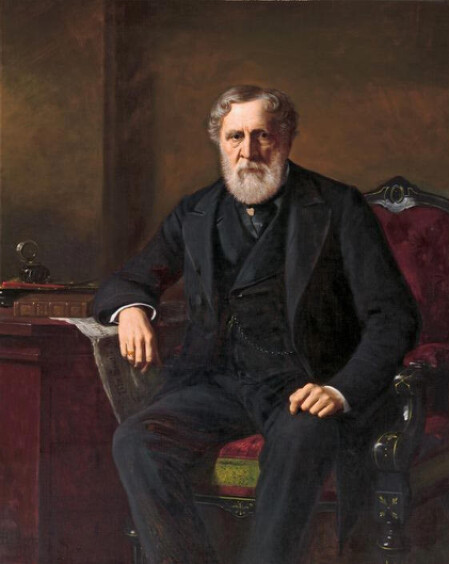
Jacob Montefiore
At the time of the abolition of slavery in 1834, Jacob was living in Grosvenor Place, London. Jacob and his brother were put in charge of a trust for the children of John Taylor which was responsible for the administration of the compensation awarded for an estate in Barbados which included 20 enslaved people. The two brothers also applied for compensation for the Caledonia estate in Barbados but were unsuccessful in their claim. Jacob lived for most of his life at various addresses in London but was in Hove at the time of the 1861 census. How long he lived in Hove we cannot say. He died at home in London in 1895. He and his brother are excellent examples of the merchant class that traded with colonies and whose names are to be found in the SCC records.
John Brome 1808-1875
John Brome was living at 37 Brunswick Square in the last years of his life. He was described at his death in 1875 as ‘late of Brighton’. Brome was the son of Revd John and Elizabeth Brome. When his father died in 1828, John Brome inherited two estates in Barbados - Bromefield and Hannays estates.
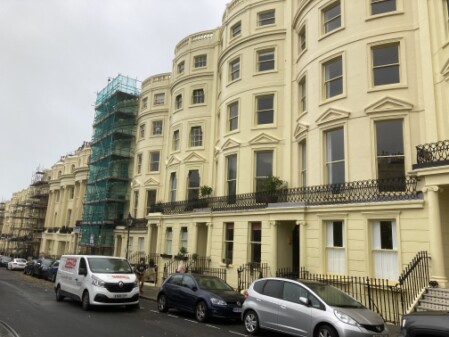
Nos 37-39 Brunswick Square
Brome was born in London in 1808 and baptised at St Marylebone on 2 November 1808. He later attended Charterhouse School before going up to Trinity Cambridge, from where he matriculated in 1831. He was then admitted to the Inner Temple in 1832.In 1833, Brome was possibly the instigator of a petition urging absentee plantation owners to sign rather than continue to delay what he regarded as the inevitable abolition of slavery in the British Empire. Brome applied for compensation for the two plantations he had inherited from his father and, despite a counter claim by trustees on behalf of his widowed mother, Elizabeth, and his sister Emily, he was awarded compensation amounting to £6,542.
In 1841, Brome, now 25, was living at Hanworth Road, Ham with his mother and sister and her son. A decade later, Brome was living with his sister, Frances, and her husband, William, together with his mother, Elizabeth, at Norwood Green, Middlesex. In the 1840s, Brome was subjected to a lunacy commission, which explains why he was never to establish himself as an independent person. At the time of his death on 18 December 1875, Brome was staying at 37 Brunswick Square, Hove.
Richard Lane 1794-1870
Richard Lane died at 38 Brunswick Square on 26 January 1870. He was born in Langham in Essex, the son of Thomas Lane of The Grange, Leyton and Barbara Fowler. Thomas Lane had inherited Newtons and Seawells estates with his brother, John, in 1794, and divided the two estates in 1820 with Thomas taking Newtons and John taking Seawells. Thomas was a London solicitor, and Solicitor Clerk to the Goldsmiths Hall. It is thought that his son, Richard, took on Newtons estate following the death of Thomas in 1824, although the LBS project is not clear on this as there is the possibility of confusion with Richard Stuart Lane.
For four years between 1820 and 1824, Lane played first-class cricket. He was a member of MCC and played four known appearances in first-class matches. Lane married Sarah Tracey in the late 1820s and their first child, Richard, was born in 1829. They had a further six children. In 1836, Lane was awarded £5,538 as compensation for the 262 enslaved people who would receive their freedom following the apprentice period.
Sir Ralph Darling 1772-1858
Sir Ralph Darling was a colonial administrator who lived at 39 Brunswick Square from 1837 until 1858. Born in Ireland in 1772, the eldest child of Christopher Darling, a soldier in the 45th Regiment, and his wife Ann, Darling moved to the West Indies with his family in 1785. He was a soldier in the West Indies, 1786-1802, but he did not own or benefit from the ownership of slaves - unlike his brother, who was awarded the compensation for six enslaved people in Dominica and was also the beneficiary of one-third of the compensation for the Springfield estate in Dominica.
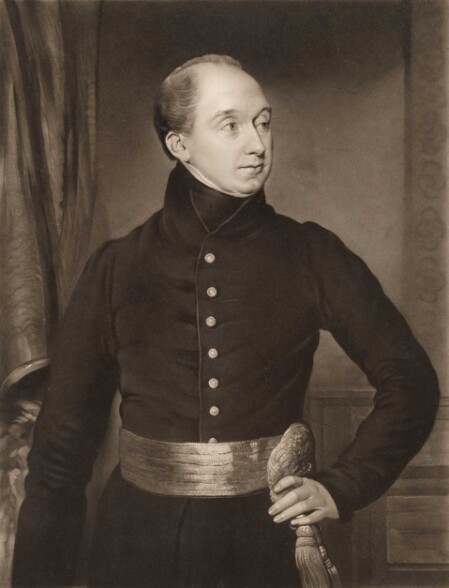
Sir Ralph Darling was a British military officer who had an illustrious career in the army before taking on the civil role of Governor of New South Wales 1825-1831. He had entered the army as an enlisted man and rose to Deputy Adjutant General. As Governor of New South Wales, Darling introduced many improvements to the machinery of the colonial government, including well needed monetary and banking reforms, but he found it difficult to move away from the authoritarian mode of rule that he was used to in the army.
Darling had joined the army in 1786 and served in the West Indies. In 1793, after seven years in the army, Darling was given an officer’s commission as an ensign in the 45th and continued to serve in the West Indies until 1802. He was promoted to captain in 1796 and became military secretary to Sir Ralph Abercromby, the British Commander-in-Chief West Indies. Darling excelled at his new administrative duties and on the front line, and he continued to receive rapid promotions.
In February 1819, Darling was sent to Port Louis, Mauritius, to take over the military government of the newly acquired colony, his first civil position. The island had been taken from the French in 1811 and most of the island’s European residents were French. The economy of the island was based on the sugar industry, which relied on the labour of the 70,000 negro slaves. The slave trade using British ships had been declared illegal in 1807 but the plantation owners on the island continued to smuggle in slaves. Darling was appointed to end this trade and to do what his predecessor had failed to do. He set about his task with little consideration of the views of the local council and the plantation owners and not for the first time he found himself clashing with the local elites, especially after his dissolution of the island council. He was later to serve with distinction as Governor of New South Wales although his tough approach to dealing with criticism resulted in him being the subject of an enquiry which exonerated him after he had returned to Britain. He lived in Cheltenham for several years but in 1837 the family moved to Brighton where he remained until he died in 1858.
Sir Orford Gordon 1786-1857
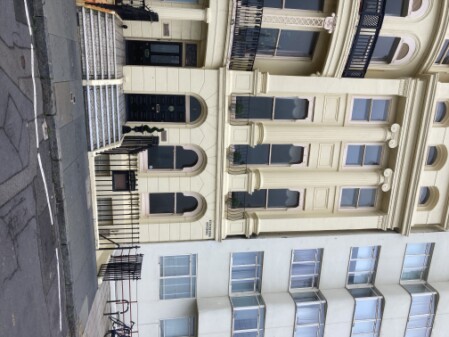
Sir Orford Gordon was a former army officer living at 1 Brunswick Terrace at the time of the 1851 census. He succeeded to the Baronetcy of Elbo of Sutherland on the death of his brother in 1804. He was a Captain in the 78th Highland Regiment. His cousin was Robert Home Gordon, who lived off the wealth generated by three estates in Jamaica – the Cromwell, Dornock and Home Castle estates. Robert Home Gordon became embroiled in an adultery case in which he was the defendant. Gordon eventually married Susanna Biscoe, with whom he had eloped, and they lived together for the rest of their lives, continuing to live off of the two Jamaican estates.
1 Brunswick Terrace
When Robert Gordon died in 1826, his estates passed to Susanna as his wife. Susanna claimed the compensation for the estates and was awarded almost £16,000. In 1839, the year of Susanna’s death, the Cromwell estate was registered to Mary, daughter of Susanna and Briscoe, whilst the Dornock and Home Castle estates were registered to Susanna. It is not known whether Orford Gordon inherited anything but as Mary, Susanna’s daughter, was the registered owner of the Cromwell estate in 1839, it is reasonable to assume that Mary inherited the remaining two other estates. Yet the LBS database is unclear on what happened to Susanna’s estate saying that “The estates of her husband in Jamaica passed under his will, apparently to Sir Orford Gordon”. As the LBS website in its record of the ownership of estates gives Mary as the registered owner of the Cromwell estate, it is quite likely that Orford Gordon received just a portrait of Robert Gordon by Joshua Reynolds.
There is a record on the LBS site of Orford Gordon having sold enslaved people, who had previously belonged to Robert Shaw, to Isaac McCorkell and James Thompson of the Christiana estate in Manchester, Jamaica. Orford Gordon also put in a claim for compensation for 75 enslaved persons as the heir of Robert Shaw. He was unsuccessful in his claim. It is not known in what capacity Gordon sold slaves who ‘belonged’ to Shaw and what financial reward he received. There is, though, no record of Sir Orford Gordon owning slaves on the LBS site. Sir Orford Gordon was, according to the 1851 census, living at 1 Brunswick Terrace. He died six years later in 1857. His family home remained Embo House, Dornoch, Sutherland.
Elizabeth Murray, nee Virgin 1778-1857
Elizabeth Virgin was the only child of Samuel and Sarah Virgin of the Hope and Bull Dead estates in Jamaica. She was born and baptised in Clarendon Parish, Jamaica. Her father owned the Hope and Bull Dead estates in Jamaica which in his will were left in trust, with the profits to be paid out first to his wife, Sarah, and following her death to his daughter, Elizabeth. This was revoked in a codicil in which Samuel Virgin stated that he had amply provided for his wife and the rents and profits of his estates should go to his daughter.
Elizabeth married William Murray, the owner of a number of estates in Jamaica. William said in 1815 that he had lived almost 20 years on his sugar plantation in St James, Jamaica. As well as his own considerable property, William managed several other estates for friends in England. Following the death of Elizabeth’s father in 1815, his estates of Hope and Bull Dead were registered in the name of either William Murray or Murray’s attorney in Jamaica, John Griffith, until 1839 after which the Compensation Commission did not record what happened to the estates. Elizabeth, though, continued to receive the monies from rent and the profits of the estates. At the time of the compensation payments in 1834, Elizabeth and William were living in 8 Lower Grosvenor Street, London. The compensation payments for all the estates were either to William Murray or to his attorney, John Griffith.
William died in 1845/46 and left all of his estate to his wife, Elizabeth. By 1851, Elizabeth, aged 72, was living at 29 Brunswick Terrace with her grand-daughter Mary C. Floyd, three female servants and two male servants. Elizabeth died in 1857 and in the will which was made in 1852 and proven in 1857 in London, she was described as ‘a widow of Brighton’. It seems likely therefore that she resided permanently in Brighton or Hove from soon after the death of her husband to her own death.
Brunswick Town Summary
Of these seven who lived in the Brunswick estate, four received compensation from the SCC and two were unsuccessful in their applications for compensation. One, Sir Ralph Darling, is not known to have benefitted directly from the benefits of the slave trade although, whilst he was living with his family in the West Indies, the family probably had black servants. None of the group was living in Brighton or Hove at the time of the development of the Brunswick estate. Hankey and Darling were probably permanent residents of Brighton whilst Lane, Brome and Murray lived in Brighton or Hove toward the end of their lives.