



Part 6
Case Study of
Brighton's East Cliff
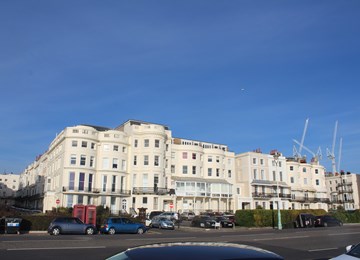
The East Cliff
In the article Reparative Histories, Anita Rupprecht and Cathy Bergin wrote that
“a significant number of awardees of slave compensation lived in, or owned properties in, Brighton. b) many of whom invested in the new luxury housing developments springing up along the seafront to the east c) colonial wealth extracted from the other side of the Atlantic, which also congealed in the city’s brick and flint. and d) in the short half mile along the sea-front, running east towards the grandeur of Thomas Kemp’s Sussex Square, records show eight properties occupied by recipients of very substantial a slave compensation monies.”
A number of the group lived in properties along Brighton’s seafront to the east of the Palace Pier, either in streets like Marine Parade, Royal Crescent and Clarendon Terrace which faced the sea or in streets like Lewes Crescent, Sussex Square and Belgrave Place which were at right angles to the sea and protected from the south westerly winds.
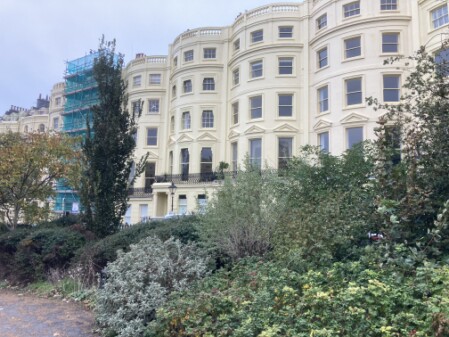
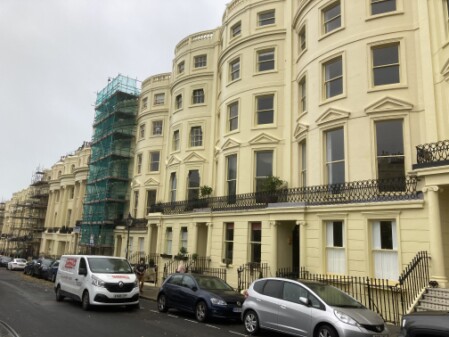
Marine Parade is described in The Encyclopaedia of Brighton as forming “the country’s most impressive façade”. Building began on the most westerly part of it in around 1790 and continued eastwards towards Kemp Town until the 1850s. The construction of a huge seawall after 1827, to protect the crumbling cliffs close to Marine Parade, helped to protect the road, and also gave rise to Madeira Drive below. Much of the eastern end of Marine Parade was designed by Wilds and Busby in the 1820s, but eastwards development was more inconsistent with buildings displaying a variety of styles. Royal Crescent was built 1799-1802 for J.B. Otto, the owner of a plantation in the West Indies, and the only person we know who owned slaves, derived an income from the slave trade and who developed a part of Brighton. Royal Crescent was built as lodging houses to be let during the season and was the first unified terrace to be built in Brighton. When constructed it stood alone on the east cliff.

Comments welcome using the Contact Form
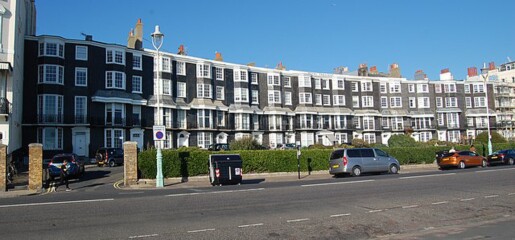
Royal Crescent
The neighbouring streets and Marine Square were built in the 1820s. Portland Place was designed by Busby and A.H. Wilds. East of Royal Crescent, a number of projects began in the 1820s to fill the land west to Kemp Town, Portland Place being the first, in1824, just a year after construction of Kemp Town began. The landowner was a Major Russell, a friend of T.R. Kemp. Further east was Belgrave Place, built by Thomas Cubitt in 1846, on land which T.R. Kemp gave him as payment for building work carried out by Cubitt at Kemp Town and in London. Percival and Clarendon Terraces were built as speculative developments from 1845-1850 for William Percival Boxall by Cheesman and Sons, a local building firm. None of these developers or builders involved in the development of Brighton’s east cliff are on the LBS database, and I have no reason to believe that any of them were connected with the slave trade. It is to be noted that much of the east cliff was constructed in the 1820s and therefore slave compensation payments could not have been used.
12 on the LBS website lived in the East cliff area of Brighton
I have found twelve people who are on the LBS database and who lived for a time in properties on Brighton’s east cliff. They are: A.P. Anderson, C.E. Anderson, G.F.de Peyronnet, J. Dawkins, C. Lushington, the Hon A. Macdonald and the Hon J. Macdonald, C. Paine, Sir R. Rice, P.L. Story, L.Taylor and E.L.Wilson.
A.P. Anderson was a medical doctor who died in Hampden House, Marine Parade, Brighton in 1840. He held a mortgage on Brewers Bay estate which he sold for £1,921 to his brother some time before 1821.
C.E. Anderson was the niece of A.P. Anderson. She died in Brighton in 1865 whilst living at 12 Bedford Street. She was described in the compensation records as being ‘of Brighton’ at the time of her death. Caroline and her sister Anna were the beneficiaries of their father’s and their uncle’s will, which included the ownership of Brewers Bay estate in the Virgin Islands. At the time of the compensation payment in 1836, Caroline was living in Brighton. She was the beneficiary of an award of £2,222 as compensation for 160 slaves. It is not known how long she lived in Brighton.
G.F.de Peyronnet, 1815-1895, died in Brighton where she had been living since 1891. She was the beneficiary, with her sister, of the compensation (£11,279) for the slaves on the Peruvian Vale and Henry’s Vale estates on St Vincent and on Plaisance on Grenada. She used the money to support her extravagant lifestyle which included travels around Europe. She settled in Brighton at 129 Marine Parade, a substantial house on east cliff, probably built in the 1820s. Whether she bought the house or rented it is not known although she would not have invested in its construction.
John Dawkins,
1774-1844, died whilst staying at 5 Marine Parade. Dawkins was the recipient of
£502 awarded as compensation for York and Gale’s estates
in Trelawney. A memorial to Dawkins exists in St Andrew’s, Waterloo Street.
Dawkins was the son of Henry Dawkins MP and attended Christ Church before
becoming a barrister at Lincolns Inn in 1800.
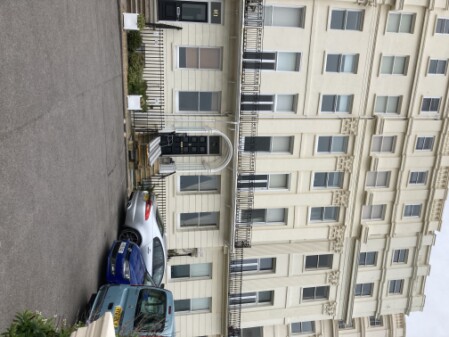
129 Marine Parade (to the left)
C. Lushington,
1785-1866, described as of Hill House, Edgeware in the LBS project, died at 118
Marine Parade. He was the husband of Sarah Lushington, who was one of the
beneficiaries of a trust whose trustees were paid ¾ of the compensation for
slaves on Seven Plantations in Clarendon, Jamaica. Charles and his wife were
unsuccessful claimants for the remaining ¼.
Charles was an East India Company servant and was Secretary
to the government of Bengal 1823-1827. On his return to England, he became MP
for Ashburton 1835-1841 and for
Westminster 1847-1852. He was a reformer in favour of the ballot and triennial parliaments and
for an extension of the suffrage. He opposed all religious privileges and
published three books on religious questions. It was surprising to find
Lushington as a beneficiary as his brother was one of the most prominent
advocates of the abolition of slavery and was active in the campaign to abolish
slavery.
The Hon A. Macdonald, 1777-1861, died whilst living at 9 Belgrave
Place, Brighton. Letters of administration relating to his death describe him
as “formerly of Connaught Place Edgware Road but lately of 9 Belgrave Place
Brighton”. He was the beneficiary of a trust which received three awards of
compensation for the Argyle, Calder and Calder Ridge estates in St Vincent.
Macdonald was a founder member of Arthur’s, the first West End members’ club in
1811. It would appear that he was in Brighton for a temporary visit and that
his permanent address was Connaught Place in London.
The Hon. Jane Macdonald, the wife of the Hon. A. Macdonald, died
whilst staying at 12 Belgrave Place, Brighton. She benefitted from a trust set
up for her marriage and from which both she and her husband benefitted. Like
her husband, she was described in the letters of administration relating to her
death as “formerly of Connaught Place
Edgware Road but lately of 9 Belgrave Terrace Brighton”.
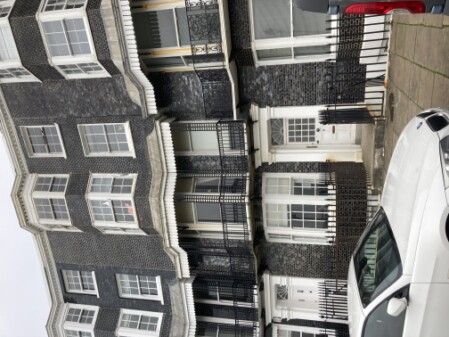
Sir R. Rice, 1781-1851, was the beneficiary of £3,579 awarded as compensation for estates in Clarendon, Jamaica. Rice was a barrister and judge, and awarded the compensation as a trustee, under the will of his father. He died at his house, 6 Royal Crescent, Brighton, in 1851, having lived there since 1834. He can be regarded as a permanent resident of Brighton but, living in a house built between 1799 and 1802, he was not involved in its building.
C. Paine, 1785-1869, was brought up in Brighton. His father, Cornelius, after whom Cornelius was named, was a Brighton Town Commissioner. Paine became a London West Indies merchant, one of many such merchants who had interests in the sugar plantations. He was awarded the compensation of £5,061 for the Farrels and Reeds Hill & Spring estates on Montserrat. Whilst a merchant in London, he lived in Islington but, when he retired, between 1841 and 1851, he moved back to Brighton and set up home at 9 Lewes Crescent, one of the most prestigious properties in the town. He is described in the 1851 census as a ‘retired colonial broker’. He died in Brighton in 1869
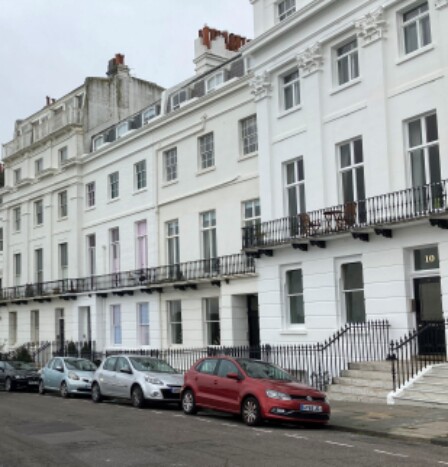
9 Lewes Crescent
P.L. Story died in Brighton in 1843. He was the recipient of an award of £1,977 as one of a group of trustees for the Lower or Lower Windward estate on Montserrat, although it is not clear for which marriage settlement he was a trustee. Story matriculated from St John’s Cambridge in 1801 and then went to Jesus College, leaving in 1802. He was ordained as a deacon in 1806 and became a priest in 1808. He became a curate in Lincolnshire. He had been living at 25 Sussex Square just before he died in Baden-Baden in 1843.
Letitia Taylor, 1791-1864, was the eldest daughter of Ballard Beckford Nembhard, owner of Hounslow estate in St Elizabeth, Jamaica. In 1819, she was bequeathed £6,000 in trust in the will of her father. Letitia received the interest on the capital until her death in 1864 when her children received the capital. She married William Raynsford Taylor of the Madras Civil Service in Southampton on 27 March 1817 and was living at 3 Clarendon Terrace, Brighton in the census of 1861 with her husband and two daughters. It is not known where she was living when she died.
E.L.Wilson made an unsuccessful claim on behalf of his wife, Louisa, for the compensation for the Stone Fort estate in St Kitts. At the time of his claim for compensation in 1835, he was living at 30 Marine Parade but at the time of his death on 7 December 1850, he was described as of Taunton.
East Cliff Summary
Of these twelve people who lived along Brighton’s eastern shore, five received direct compensation from the SCC, five received compensation from a trust fund set up with SCC money or were trustees, whilst two further people did not benefit from the payments made by the SCC. The total payments of compensation received amounted to £24,620 not including those amounts that were to be paid in trust to the parties concerned.None of this group was living in the stated address at the time of the property’s construction as nearly all of the properties associated with this group were built prior to their arrival in Brighton.