



What Impact did the British Empire have on its Subject Peoples?
Settlers came with good intentions
The British Empire was formed over three hundred years, by private interests, and with little initial involvement of the imperial government in London. By 1900 there were over seventy different territories, governed in different ways and established for different reasons – some for trade, some for religious reasons, some for settlement and some for strategic or geopolitical reasons. There was the informal empire with no direct British authority, and the formal empire consisting of protectorates, colonies, and dominions. With communications between London and imperial territories very limited until the late 19th century, decisions about law and order, customs and trade, taxes, dealing with local tribes, and whether to introduce Parliamentary government and extend the franchise were left to the ‘Man on the Spot’ who might be a despot seeking to exploit the land and its people, or a reformist seeking to improve life for local people.
When the first settlers arrived in Virginia in the early 17th century they came with the intention of living in harmony with any local people. The people they came across were relatively primitive, knowing little of the horse, firearms, and metal goods but they did know how to grow maize and cultivate, and use tobacco. Initially there was a period of trade and mutual dependence, and the hope that local tribes could be converted to Christianity. However, the white settlers had little understanding of the local culture and the local people found the idea of individual land ownership repugnant. Cultural differences bred friction and soon open warfare. The local tribes were no match for the settlers who had far superior technology, and once the tribes were seen as an obstacle to be removed, a constant state of warfare replaced the harmony that had briefly existed. So was established the pattern of so many territories where white settlers came across native people.
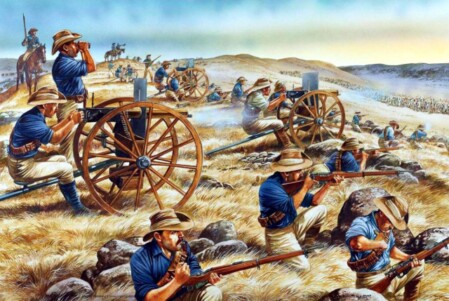
The British Empire was established for reasons of trade, settlement, and religion and where the empire came across native peoples, the result was often the exploitation, oppression, and subjugation of those people. How this would occur depended on how the local people were initially perceived by the British. The Australian aborigines were regarded by the British as extremely primitive and lacking any culture. They did not have the means to confront the British and were simply ignored by the British who gave away their land and at times allowed settlers to shoot aborigines on sight. This was in contrast to the Matabele people of South Africa who were a martial people with a large army and who were tricked by Cecil Rhodes into signing the Rudd Treaty, and eventually destroyed by a military force armed with the new Maxim gun. The result was the same: the loss of culture, land, livelihood and self-esteem, and the constant threat of force to be used against any resistance to British authority. Persuading a local tribal leader to sign a treaty by which the British agreed to protect the leader from threats posed by neighbouring tribes in return for allowing settlement and the extraction of raw materials was often followed by the British reneging on promises made, and the slow loss of control over his or her own country.
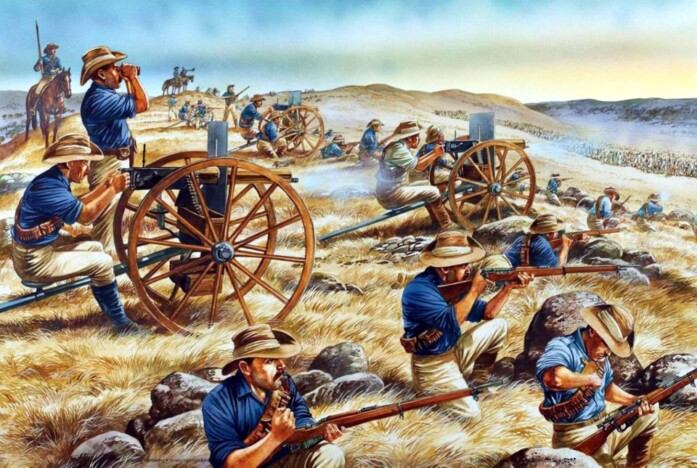
3,000 Matabele were killed for the loss of one white soldier as the Maxim gun dominated the Matabele wars of the earrly 1890s, wars which destroyed the Matabele nation
Rule with consent
The British did not have the military means to keep native people under military rule. There had to be an element of consensus and the British did strike bargains with local elites. In India, the British kept over 600 Indian princes in power, supported with a pension and the potential use of the Indian army, but only as long as the Prince ruled according to the wishes of the British Resident. Elsewhere bargains were made with local elites who were either kept in power or promised a role in government.
The British Empire, like nearly all empires, resulted in misery for local people, but there were sometimes benefits. The British introduced their own laws and often brought stability where previously there had been internecine strife. The British introduced new crops and methods of agriculture, modernised transport, introduced hospitals and schools, all of which may remain today. They also introduced a system of justice and parliamentary rule which also largely remain in former British colonies. However, this was often done at the expense of local culture.
A Liberal empire?
19th century British politicians believed that the British Empire was a liberal empire, and this marked it out as being different from all other empires. They believed that the British had a sense of duty towards native peoples and that colonial government was a trust to be exercised for the benefit of subject peoples who would eventually receive self-government. Lloyd George in 1921 told the Imperial Government that the British Empire was unique because ‘Liberty is its binding principle’. The idea of the motive for empire being a civilising mission given to Britain by God took hold in the late 19th century with Public Schools educating boys to go abroad, found and administer colonies for the benefit of Britain and local people. Empire was seen as the key to wealth and prosperity and was justified by the ‘Mission to Civilise’. The reality was that, apart from the white dominions, no colony received independence as a result of the British willingly surrendering control.
The Mission to Civilise
This Mission to Civilise was based on the idea that Britain was at the top of the racial hierarchy and had a culture superior to any other nation. It became Britain’s duty to wipe out elements of local cultures that were regarded as barbaric and savage. In India attempts were made to wipe out thuggee and suttee and replace Hinduism with Christianity. In Africa missionaries tried to suppress slavery once Britain had abolished slavery in the empire and attained the moral high ground. In New Zealand, attempts were made to eradicate cannibalism and the traffic in tattooed heads whilst in Hong Kong the authorities tried to stop foot binding and infanticide.
The District Officers of the Indian Civil Service
The administrative soldiers of the British Empire who were in the vanguard of introducing new methods of agriculture, administering justice, and introducing social and political reforms were the District Officers. Such men, so admired by Kipling, spent months alone in isolated places in alien climates amongst peoples with vastly different cultures, as the only representatives of the Empire. Having received an education at one of Britain’s public schools and then taken a Civil Service exam to gain admittance to the Indian Civil Service or an equivalent, these men took their jobs very seriously. They often believed that they were there to improve life for local people. They spent their time travelling around their allocated region, which might be the size of several counties, living in tents in extreme heat, and adjudicating disputes and supervising the progress of local projects. They administered the building of roads, dams, and irrigation systems, and collected local taxes. They introduced schools and sometimes hospitals and worked alongside local princes to ensure that ‘good government ‘was being provided by the independent princes. These men were often brave, industrious, and honest but often exuded an arrogant attitude towards native people. With racist attitudes more and more prominent in late Victorian Britain following the Indian Rebellion and the rise of Social Darwinism, more and more District Officers began to take the view that native people were incapable of economic, political and social development. They became more interested in maintaining the status quo so that the Governor of Bengal could claim that ‘Bengal has no irrigation or drainage, no education, no cottage industries, completely inadequate hospitals and no machinery to cope with distress. There are not even plans to make good these deficiencies.’ Racial incidents involving the maltreatment of Indians became more and more common despite attempts to eradicate them. When Lord Curzon became Viceroy of India in 1899, he saw himself as an enlightened autocrat, and someone who loved Indians, but when he tried to intervene to stop the way in which British people acted with impunity towards Indians, although he was able to punish the perpetrators of violence he wasn’t able to change racist attitudes.

Members of the Indian Civil Service
With India having no more than 100,000 Europeans governing and administering 300 million people, this could only be done with an element of consent. Sometimes agreements broke down bringing reprisals. On the North West frontier, the support of the militaristic Pathan leaders was bought with a pension. If these leaders failed to follow the rules laid down by the British, Pathan villages would be subject to destruction by military forces.
Famine in India
India became vital to Britain’s economy in the late 19th century and the improvements referred to were usually for the benefit of that trade. When famine came to India the British failed completely to deal with the situation. The British may have been able to build railways, bridges, and roads but when famine occurred the British adherence to the policy of laissez-faire resulted in millions dying. In 1876 and 1877 there were two successive seasons of inadequate rainfall in which 58 million people faced chronic food shortages. Millions died as there were no railways to the places affected, and the work camps were sited far from the areas of scarcity. Railway building and irrigation projects were increased so that by 1891 there was an additional 10 million acres of land available for cultivation. When famine struck again in 1895 and 1896, 53 million faced starvation. There was more relief now available and government labour camps helped but the Viceroy, Lord Elgin, refused to interfere with the market and allow government to buy grain and distribute it to the needy. In the 1899-1900 drought 800,000 died in the Bombay Presidency alone. More help was now being provided with more railways and more canals, but the British authorities never lost sight of the fact that India had to pay its way. Where there were to be improvements, it was imperative that they resulted in more taxes being paid. This was the pragmatic approach which led Churchill to refuse to divert scarce resources to Calcutta during the famine of 1943-44.
Men who introduced social and economic reform
There were though pro-consuls who devoted their lives to the improvement of those under their care. The degree of reform introduced into a colony was dependent on who was in charge. Typical of the men who did improve their colonies were Sir Frank Swettenham, Sir Frederick Lugard and William Des Voeux. During his time in Malaysia, Swettenham managed to bring a measure of law and order to a region that was beset with piracy and endless wars of succession between local sultans. Arriving in the Malaysian peninsula in the 1870s, he resolved to learn the local language and get to know the local people. He was given the task of persuading local leaders to agree to a measure of British involvement in their administrations, and eventually was appointed the British Resident to several Sultans. He set about improving Kuala Lumpur, building new hospitals and civic buildings, and investigated the introduction of new rubber crops. He encouraged British settlers and investment and within a generation he had transformed a roadless jungle of 25,000 square miles, inhabited by 500,000 people into a colony with modern towns and a thriving economy based on rubber. However, by 1903, local chiefs were beginning to resent the way in which the British had taken over their territories and persuaded them to sign unequal treaties.
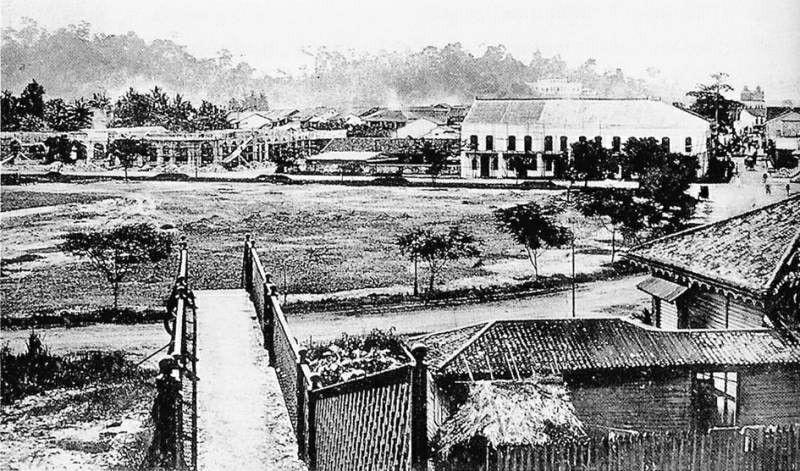
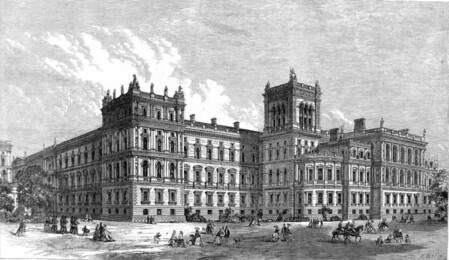
Government buildings in Kuala Lumpur under construction
Henry Bell
Henry Bell was a career civil servant in the Colonial Office who tried to improve the territories he had responsibility for. As administrator for Domenica in the 1890s he built a road from one side of the island to the other and founded a model plantation to grow cocoa, limes, vanilla, and oranges. He was instrumental in persuading insurance companies to insure property against hurricanes. He then looked forward to a posting in a place with a moderate and gentle climate but was posted to Uganda as its first Governor. He arrived in 1906 in the middle of an epidemic of what was known as sleeping sickness. There was already a medical team working on the cause of the epidemic which was killing thousands of native people. The death toll was 200,000 when Bell arrived and he himself went down with blackwater fever and dengue. The medical staff in the territory soon discovered the cause of the illness was the tsetse fly, and that those living near water were most susceptible to the disease. Bell resolved to free Uganda of the tsetse, and he first persuaded the local tribal chiefs to allow their people to be relocated to safer areas away from water. Special isolation camps were established, and safe pathways were established to enable local people to access water. Within two years the death toll had fallen to just 82, and eventually as the infection disappeared from the previously infected areas, people were allowed back to their ancestral homelands. Bell’s method of dealing with the sleeping sickness continued to be used until the 1960s. Bell was also active in trying to improve Uganda in other ways. He had new roads constructed and persuaded Ugandan people to use elephants for hard labour. Bell was impressed with the fertility of the soil in Uganda and wanted to introduce Indian and Chinese indentured labour to set up agricultural settlements and establish model plantations. He saw the future of Uganda as lying within the hands of its own population. He did not want white settlers to take over and regarded Uganda as having an ideal opportunity to produce a stable African state.
There were many other Governors and administrators in the Colonial Service who saw their role as to introduce social and economic reform. Men like Sir Frederick Lugard and William Des Voeux worked hard to improve the stability of their territories by providing law and order and introduce economic reforms. There were also Governors who worked to provide more land for European settlers at the expense of native people. Such a Governor was Sir Bartle Frere who wanted to subjugate the Zulu people, just as the Xhosa people had been defeated before them, to provide a safe environment for settlers to farm and for more land to be made available for incoming settlers. Against the orders of Disraeli’s government, Bartle Frere provoked a war against the Zulu people, which resulted in the greatest disaster for the British army in the 19th century, but a defeat that had to be avenged.
They ran their territories as they liked
Representatives of the Colonial Service, like Swettenham, Bell and Bartle Frere were free to run their territories as they wished. Whether they improved a territory for local people depended vary much on their own personality but also on the nature of the colony. A settlement colony like Australia, New Zealand or South Africa needed to attract settlers to improve the economy and provide greater security. This was nearly always done at the expense of the local people whose land was either taken from them or they were deceived into signing unequal treaties. When the British took over the Cape Colony from the Dutch in 1806 they created a colour blind franchise. With the abolition of slavery in the 1830s, there was the hope of a more egalitarian society in south Africa but the need for more European settlers created the demand for more land to be taken from the Xhosa people of the Eastern Cape. Ten frontier wars were fought until the Xhosa ‘agreed’ to lose their ancestral lands. An attempt to extend the territory of the Cape Colony eastwards was thwarted by the imperial government who reversed the annexation of Kaffraria. However, pressure for more land by the colonial authorities in Cape Town, eventually led to the imperial government agreeing to the annexation of Kaffraria. When Cecil Rhodes became Prime Minister of the Cape Colony in 1890, he made it more difficult for native people to vote and reduced by half the number of black voters. Rhodes also duped the chief of the Matabele people, Lobengula, to sign a treaty giving Rhodes’s company exclusive rights to mine in Matabeleland. With the British government giving Rhodes a charter to create a company that had all the powers of a government, and then use this charter to settle lands north of the Transvaal, Rhodes used his new powers to create an army that in 1893 invaded Matabeleland and with the new Maxim gun, destroyed the Matebele army. In two battles 3,000 Matabele were killed for the loss of one white soldier. Lobengula fled and died soon after – his kingdom to be taken over and settled by Europeans.

The Xhosa people fought ten wars against the British in South Africa to save their homelands
Violence was commonplace
Violence against native people was commonplace in the British Empire. Although there was always an element of consent involved in any British administration, there was always the threat of violence against subject peoples if there was resistance to British authority. Whenever there was resistance from a whole community British reprisals could be excessive. Following the Indian Rebellion of 1857 in which 10,000 Europeans lost their lives, the Indian army scoured the territory of northern India looking for possible rebels. Thousands were hunted down and given summary justice.
The Pathan people were continually subjected to punitive expeditions on the North West frontier of India. In Tasmania in the 1830s there was an attempt to wipe out the population of native people, and despite its failure subsequently hundreds were exiled. In Ceylon in 1818 the British killed over 1% of the local population in retaliatory raids and 30 years later 200 rebels were hung or shot despite no European being killed. Following an uprising by a few hundred people in Jamaica in 1865 which left 18 dead, the reprisals ordered by Governor Eyre resulted in 439 Jamaicans being hung and 600 flogged with 100 houses destroyed.
What if there had been no British Empire?
The standard view of the British Empire today in the media is that it had little merit and had only a negative impact on its subjects. Whilst it is true that there was a clear contradiction between the idea that the British Empire was an empire of liberty and the need to extend and maintain that empire by force, it would be misleading to say that it had no beneficial impact. Roads and railways were built which while they helped to promote trade with Britain also provided opportunities for local people. Local officials did work to improve agriculture by extending irrigation and introducing new crops. Such crops may have been on large plantations owned by European companies, but they did provide work and the basis for a sustainable economy after independence. Hospitals and schools were built which benefited local people. The British may have imposed their own laws which in places outlawed practices regarded as barbaric by the British, but the District Officers provided a rudimentary form of justice, and stability. However, it is also true to say that in many colonies the native people were turned from a people living on land held communally and living on subsistence farming into an industrial workforce to become the labour force of global companies, thus losing their economic independence.
We cannot say what might have happened had there been no British Empire. Would other European powers have replaced the British, or other militarised societies like the Zulu or the Asante? Would local people have necessarily been better off. We cannot assume that they would have been better off, and we cannot return to a mythical pre-capitalist age. Capitalism is expansionist in nature. Industrialists are always looking for new sources of minerals and new markets, and consumers want new products at low prices. The British Empire was based on global free trade, and trading patterns introduced by the British in the 19th century are still with us today. Today we are a more consumerist economy than ever. The age of empire is behind us, but neo-colonialism is very much with us.
Imperialism is today a very much discredited creed and an audit of the impact of the British Empire would be very much in debit, but as shown there were benefits for subject peoples. There is little doubt that empires at best were paternalistic, and at worst were racialist, exploitative, oppressive, and based on the use or threat of violence.
Further Reading:
Brendon, Piers, A Moral Audit of the British Empire, History Today, October 2007
Darwin, John, Unfinished Empire, 2012
Lang, S, Are All Empires Bad? 2016
Williams, Stephanie, Running the Show, 2011
Related Pages