


Elizabeth Macarthur
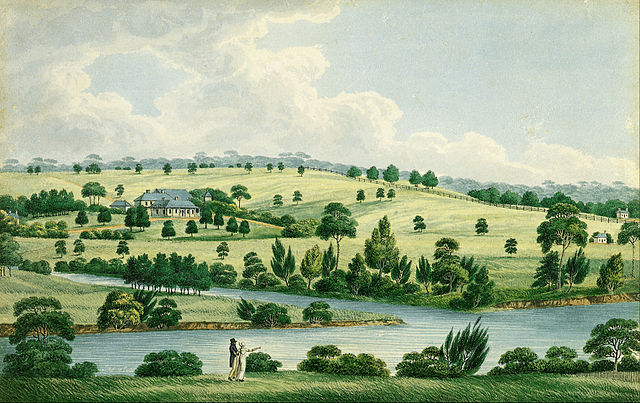
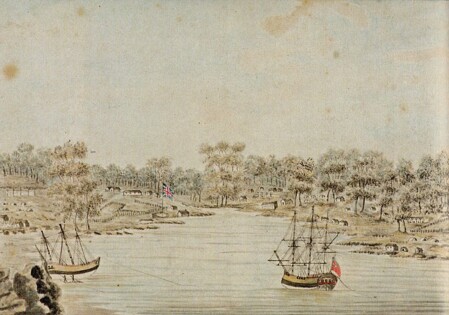
The Macarthur residence in Parramatta
Brought up in Cornwall and the first soldier's wife to settle in New South Wales
Elizabeth Macarthur sailed to New South Wales with the Second Fleet in 1790 accompanied by her husband, John and her son Edward. She was the first soldier’s wife to settle in the new colony of New South Wales, and despite her husband’s disputatious nature and his frequent absences from the colony due to the various trials he had to attend, she was accorded the respect and social standing her charm and good manners deserved. Her children were brought up in a calm and orderly household and provided with a good education by Elizabeth. During the many absences of her husband Elizabeth managed the family estates and played a large part in the development of the wool industry in New South Wales.
Elizabeth was born in 1766, the daughter of provincial farmers, Richard and Grace Veale from Cornwall. When her father died when she was just four years old and when her mother re-married seven years later, Elizabeth was brought up by her grandfather, John and various friends. At the age of twenty-two, Elizabeth married a Plymouth soldier, John Macarthur, and two years later Elizabeth and John together with newborn Edward, set sail for New South Wales aboard the Neptune with the New South Wales Corps.
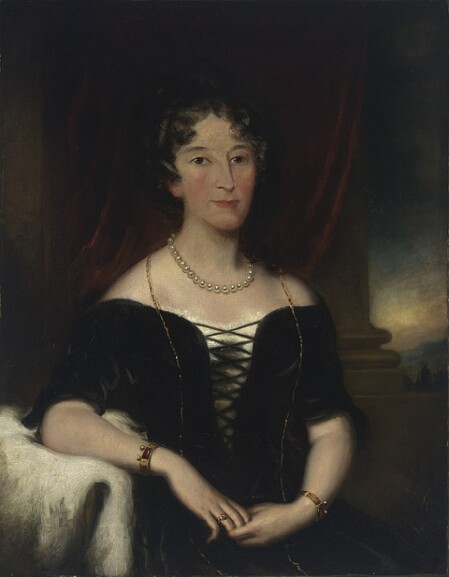
Elizabeth Macarthur
John’s argumentative nature was soon shown, when he got involved in an argument with the first master of the ship which ended in a duel. He continued to argue with the next master and before the Neptune arrived at Cape Town, Macarthur transferred his family to the Scarborough. The family arrived in Port Jackson on 28 June 1790 and the family settled down to colonial life in primitive conditions. Macarthur probably hoped for a quick promotion and a return to England but a year later he was transferred to the Rose Hill settlement. Elizabeth’s letters, written during the voyage out, and sent to her family, remain an outstanding contribution to our understanding of travelling on the early convict ships.
Elizabeth, being well educated and articulate, was able to hold court amongst a group of officers and wives, and members of the colonial administration who met to discuss astronomy, botany and other subjects of interest.
An early governor Arthur Philip, enjoyed Elizabeth’s evenings although later governors found they could not visit the Macarthur home because of John’s behaviour and the controversial position it would put them in.
In these early years in the colony, Elizabeth had four more sons, James (born 1793), John (1794), James (1798) and William (1800), together with three daughters, Elizabeth (1792), Mary (1795) and Emmeline (1808). Her life was hard, and she never allowed the difficulty of bringing up a large family to get her down. Her letters home suggested she adapted quickly to colonial life, and these were happy years.
By 1794 Macarthur and his family were living in Parramatta as he had been appointed inspector of works. Grants of land and gifts of stock enabled Macarthur to establish Elizabeth Farm on a 100-acre site. With unrestricted use of convict labour, 50 acres of land was soon cleared, and this earned another grant of 100 acres. Macarthur soon was one of the largest owners of land in the colony, and the sale of produce from the farm to the government was soon realising several hundred of pounds. Elizabeth described the farm as ‘a very excellent building’ and the country as ‘having numerous advantages to persons holding appointments under Government…We enjoy here one of the finest climates in the world. The necessities of life are abundant and a fruitful soil affords us many luxuries. Nothing induces me to wish for a change but the difficulty of educating our children…Our gardens with fruit and vegetables are extensive; and produce abundantly. The greater part of the country is like an English park, and the trees give it the appearance of a wilderness, or shrubbery commonly attached to the habitations of people of fortune.
The style of life was close to that of minor gentry back in England. There was harmony and order in the Macarthur household which was a contrast with what was going on in Macarthur’s own life. The children received a thorough education, with secular and religious aspects to it, and there was a dignity to the upbringing of the children so that the family escaped the criticism that might have come their way because of John’s behaviour.
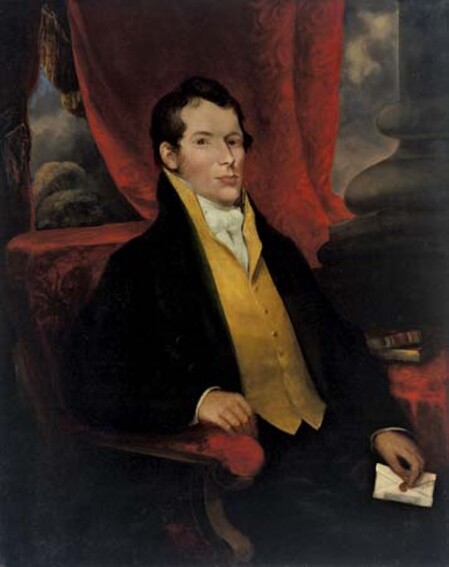
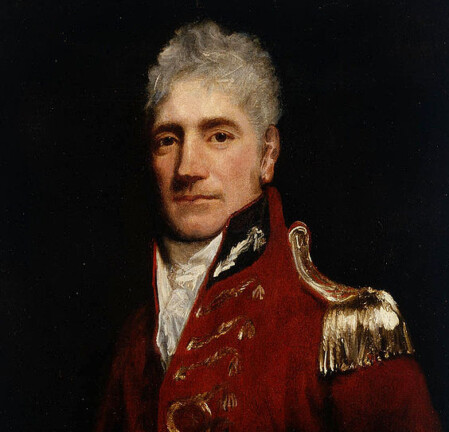
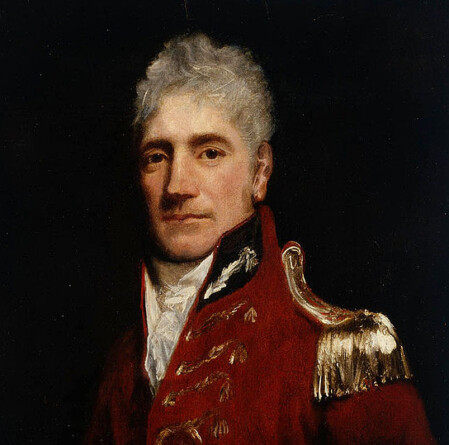
John Macarthur
Macarthur fell out with many of his superior officers
Macarthur fell out with the naval governor, John Hunter, and in 1796 he lost his position as inspector of works. There followed arguments with Richard Atkins and William Balmain, and then a campaign against the next governor, Philip Gidley King. When Macarthur wounded a superior officer in an illegal duel, Macarthur was arrested on the orders of King. Macarthur was sent to England to stand trial, sailing in November, accompanied by two of his children. He took with him a number of specimens of fleeces from his own flocks, which on arrival in England were deemed to be of superior quality to the best fleeces from Spain. Macarthur soon produced a leaflet advertising his products, which helped him to gain support for the development of wool production in New South Wales. Returning to New South Wales in June 1805, Macarthur was able to buy part-ownership of a ship to develop his business as a merchant. He was also granted 5,000 acres of land which, with the assistance of 34 convicts, was made ready for sheep.
The new governor in 1806 was William Bligh who was unimpressed by Macarthur’s influence or his demands on the administration. When Bligh refused to grant bail to Macarthur, following his committal to trial in January 1808, the commander of the New South Wales Corps, Major William Johnstone, deposed Bligh and assumed control of the colony’s administration. Macarthur was given the post of ‘colonial secretary’ until the arrival of Lieutenant-Colonel Joseph Foveaux who then assumed command. By now, Macarthur had business interests in the whale and seal industries and the sandalwood and pork trades.
In England for eight years
In 1809 Macarthur was authorised to leave for England to support Johnstone in his defence in England. Macarthur was away from Elizabeth for eight years during which time she managed the merino sheep business. She travelled around the colony looking at the various merino flocks to talk about the choice of rams, sales of sheep, and how the flocks could be improved. Elizabeth managed the Camden Park Estate and also the convict labour on the estate.
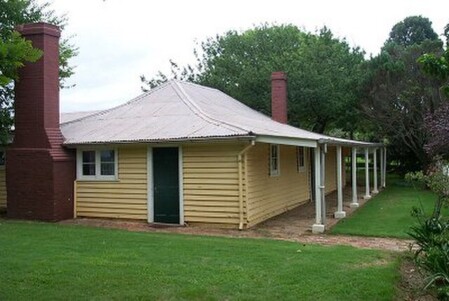
Belgenny Cogttage on the Camden Park estate where the Macarthurs lived
To do all this Elizabeth had to travel through country that was often dangerous due to sporadic fighting between settlers and the native people. She wrote detailed reports of her management of the sheep flocks to her husband and carefully implemented his directions for the estate. With John managing the sales of the merino stock in London and Elizabeth producing good quality wool, the separation seemed to work well. Her dedication, administrative abilities and determination to succeed ensured the success of John’s vision for the new industry.
Separation seemed to suit the Macarthurs
It seemed to suit the business to have John in England and Elizabeth in New South Wales. John provided publicity for the business and an economic vision whilst Elizabeth managed the flocks. Her letters showed no sign of being discontented with her position. On the contrary they showed concern for her children – the health of her daughters and the well-being of her sons being educated in England under the supervision of their father.
Elizabeth took strength from her Anglican faith and from her love of the colonial landscape and was able to convince her husband of the importance of remaining in Australia. When he returned to New South Wales in 1817, Elizabeth retired from active management of the Camden Park Estate and oversight of the family’s business affairs. John’s dream of New South Wales becoming a wool exporting colony, dominated by men of industry with extensive capital and large estates was realised and by the end of the 1820s Camden Park reached over 60,000 acres. Macarthur was presented by the Society of Arts in London with two gold medals for the quality of his wool. In 1824, the idea of organising the production of wool by a chartered company, a long-held vision of Macarthur, came to fruition when his son John was given control of the Australian Agricultural Co established on a 1,000,000 acre site in Port Stephens. The company prospered and Macarthur’s appointment in 1825 as one of three unofficial members of the newly created Legislative Council, was conformation of his standing in the colony.
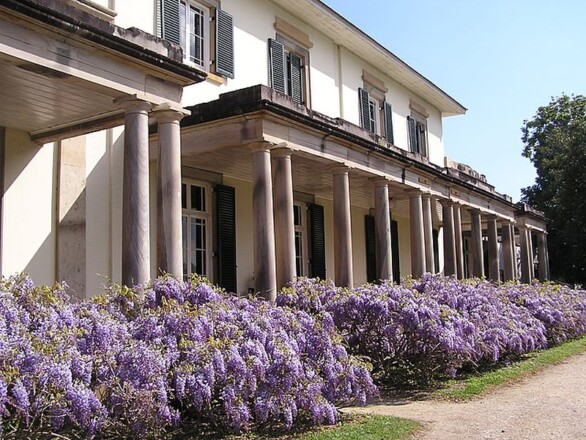
Camden Park House built for John Macarthur, 1833-1835
Elizabeth spent many of her last years in Sydney
As John developed his wool interests, Elizabeth spent more and more time in Sydney and Parramatta, and the social life centred on her children, partly the result of John becoming more and more melancholic and obsessed with the idea of Elizabeth being unfaithful. She remained devoted to her husband, although hurt by his rejection of her. She was able to persuade her sons to care for her husband, without them experiencing the tensions which existed between their parents. The couple lived their last years in virtual separation with John dying in 1834. Elizabeth lived a further sixteen years and lived to see the consolidation of the wool industry in New South Wales and its success in the mid-1830s.
Although she lived in harsh and brutal times in a small colonial society, Elizabeth never succumbed to gossip or criticism of her predicament. She provided an excellent example to her children who grew up devoted to her and with the education she gave them went on to succeed in their chosen professions. Elizabeth seems only to have elicited praise from her fellow colonists. She played an enormous part in the development of the wool industry in New South Wales, and no small part in bringing culture and education to a place where violence seemed to be the dominant force.
By Peter Crowhurst, August, 2023
Further reading:
Kate Grenville, A Room made of Leaves, 2020, (fiction)
Australian Dictionary of Biography
Related Pages: